Skip to content


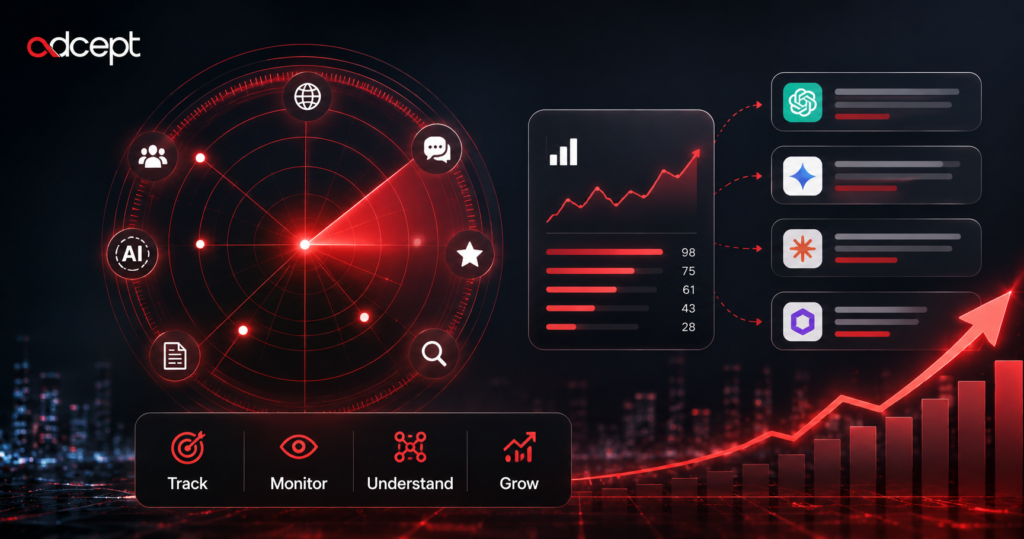
Learn what Brand Radar is, how Ahrefs tracks AI visibility, and how brands can use AI citation tracking to grow reach.
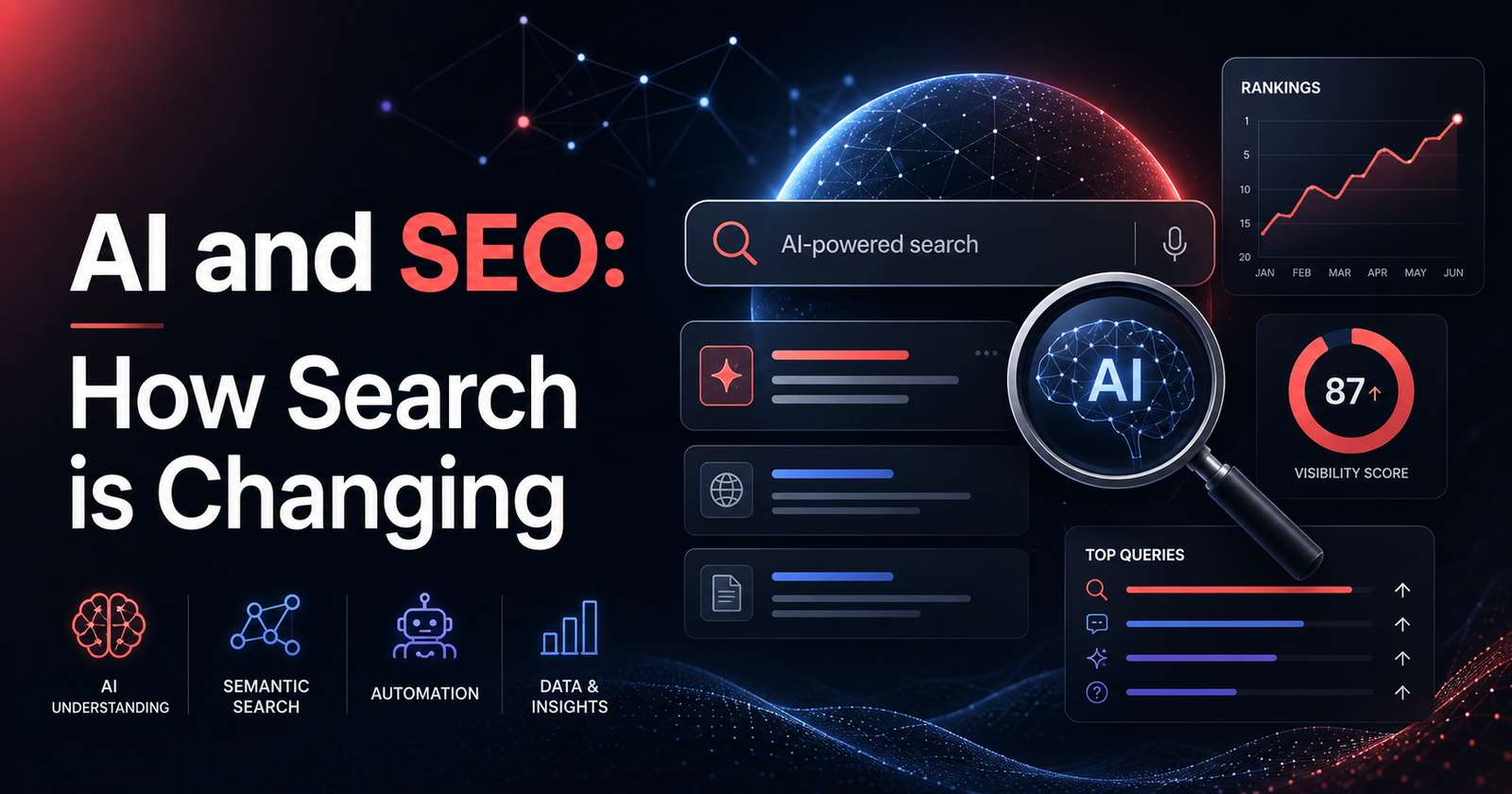
AI is changing how people search, compare and choose businesses online. For SEO Services, this means the strategy can no longer focus solely on blue links, exact-match keywords, and traditional rankings. Businesses now need clear content, strong topical authority, technical quality, local relevance and answers that both people and AI-powered search systems can understand.
Google says its AI features in Search, including AI Overviews and AI Mode, still rely on the same core Search ranking and quality systems that support traditional organic results.
That means SEO is not dead.
It is becoming more structured, more semantic and more focused on real usefulness.
This article is part of Adcept’s wider SEO content cluster. For a broader starting point, read our guide to SEO strategies for small businesses. For a deeper AI search article, see how Google AI Overviews are changing SEO strategy.
What Is AI in SEO?
AI in SEO means using artificial intelligence to improve how content is researched, structured, optimised, discovered and understood in search. It also includes adapting websites for AI-powered search features such as AI Overviews, AI Mode, answer engines and large language model responses.
AI affects SEO in two main ways.
First, search engines use AI to better understand queries, content and context.
Second, marketers use AI tools to support research, content planning, briefs, audits and reporting.
The aim is not to publish more content faster.
The aim is to create clearer, more useful pages that answer the right questions.
Why AI Is Changing Search
AI is changing search because users are asking longer, more detailed and more conversational questions. Instead of typing only “SEO agency”, a user may ask, “Which SEO agency is best for a small healthcare clinic in Melbourne?”
Search results are also changing.
AI systems can summarise information, compare options and surface direct answers before a user clicks through.
Google explains that AI Overviews help people find information faster by showing an AI-generated response when its systems decide this is useful.
This changes how businesses should think about visibility.
Ranking is still important, but being clear enough to be cited, summarised and trusted also matters.
SEO Services and AI Search Visibility
Modern SEO Services need to support both traditional rankings and AI-assisted discovery. This includes technical SEO, semantic content, entity clarity, local optimisation, structured data, internal linking and content that directly answers user questions.
A strong AI-era SEO strategy should include:
- Helpful service pages
- Clear topic clusters
- Search intent mapping
- FAQ sections
- Structured headings
- Internal links
- Schema markup
- Local signals
- Strong reviews
- Technical crawlability
- Content written for humans first
Google’s helpful content guidance says its ranking systems are designed to prioritise helpful, reliable information created for people, not content made mainly to manipulate rankings.
For businesses that want practical support, Adcept’s SEO Services Australia can help connect content strategy, technical optimisation and AI search readiness.
SEO Services for AI Search
SEO Services for AI search focus on making a website easier for both users and search systems to understand. This includes clear page structure, useful answers, entity coverage, technical health, topical authority and trust signals.
This does not mean chasing every new AI tool.
It means improving the foundations that AI search systems are likely to rely on.
What Are AI Overviews?
AI Overviews are AI-generated summaries that can appear in Google Search results for some queries. They aim to provide a quick answer with supporting links where Google’s systems determine that a generated response may be helpful.
They are not a replacement for SEO.
They are another search feature that can influence how users discover information.
How AI Overviews Affect SEO
AI Overviews can affect SEO by changing where users look first, how they compare information and which sources they trust. Pages that are clear, helpful, well-structured and authoritative may have a better chance of being understood and surfaced across AI search experiences.
This means content needs to do more than include a keyword.
It needs to answer the question clearly.
It should also explain context, compare options and support the user’s next decision.
Semantic Search and Search Intent
Semantic search is search that understands meaning, not just exact words.
It looks at topics, entities, relationships, intent and context.
For example, a page about “SEO for accountants” may also need to cover:
- Local service pages
- Google Business Profile
- Reviews
- Professional services SEO
- Lead generation
- Trust signals
- Content clusters
- Conversion tracking
This helps search engines understand depth.
It also helps AI systems summarise the topic more accurately.
Difference Between Keyword SEO and Semantic SEO
Keyword SEO focuses on matching specific phrases. Semantic SEO focuses on covering the full meaning of a topic, including related questions, entities, subtopics and user intent.
Both matter.
Keywords still help define relevance.
Semantic coverage helps show expertise and context.
For a practical framework, read Adcept’s guide to the semantic on-page SEO framework and the article on SEO content strategy.
Content Optimisation for AI Search
Content optimisation for AI search means structuring pages so users, search engines and AI systems can quickly understand the topic, answer and supporting detail.
Google’s guidance says SEO best practices remain relevant for generative AI features in Search, and that websites should still focus on helpful, accessible, well-structured content.
Useful content should include:
- Clear definitions
- Short answer sections
- Logical headings
- Direct examples
- Tables where helpful
- FAQs
- Internal links
- Source-backed claims
- Simple explanations
- Real business context
How to Optimise Content for AI Search
To optimise content for AI search, answer the main question early, use clear headings, cover related subtopics, add examples, include FAQs, improve internal links and keep claims accurate. AI search systems need content that is easy to parse, verify and summarise.
A useful structure is:
This structure helps readers and search engines follow the page.
It also supports featured snippets and AI answer extraction.
For writing quality, read Adcept’s guide on SEO copywriting.
Technical SEO Still Matters
AI search still needs crawlable and indexable content.
If search systems cannot access or understand your pages, content quality may not matter.
Google’s SEO Starter Guide explains that SEO helps search engines crawl, index and understand your content.
Technical SEO includes:
- Indexing checks
- XML sitemaps
- Robots.txt review
- Internal link structure
- Page speed
- Mobile usability
- Core Web Vitals
- Canonical tags
- Structured data
- Broken link fixes
- Redirect management
Why Technical SEO Matters for AI Search
Technical SEO matters for AI search because AI-powered search features still depend on accessible, well-structured web content. If important pages are blocked, slow, duplicated or poorly linked, they may be harder for search systems to use.
For practical checks, use Adcept’s technical SEO audit checklist.
A good SEO Services process should fix technical barriers before scaling new content.
Local SEO in an AI Search World
Local SEO remains important because many searches still include location, service area and “near me” intent.
Google’s local ranking guidance says local results are mainly based on relevance, distance and prominence.
For Australian businesses, this means Google Business Profile, location pages, reviews and local content still matter.
Examples include:
- “SEO agency Melbourne”
- “accountant near me”
- “dentist Sydney CBD”
- “ecommerce SEO Australia”
- “local SEO consultant Brisbane”
Local SEO Services and AI Search
Local SEO Services help businesses improve visibility for suburb, city and service-area searches. In AI-assisted search, clear business information, local proof, reviews and service relevance can help search systems understand who the business serves.
A strong local SEO setup should include:
- Complete Google Business Profile
- Accurate categories
- Genuine reviews
- Location-based service pages
- Consistent name, address and phone details
- Local backlinks
- Local case studies
- Clear service areas
- Schema markup where suitable
For more detail, read the guide to local SEO.
Business Use Cases
Local Service Business
A plumbing business wants to appear for local emergency searches.
AI-era SEO would focus on clear service pages, suburb pages, FAQs, reviews, fast mobile pages and Google Business Profile optimisation.
Ecommerce Store
An online retailer wants more organic revenue.
The strategy should include category page optimisation, product schema, internal linking, buying guides, product comparisons and technical improvements.
For more detail, see the guide on ecommerce SEO.
Professional Services Firm
A law firm, consultant or accounting practice needs trust before enquiry.
Content should cover service pages, industry-specific guides, case studies, author expertise, FAQs and clear calls to action.
For professional service examples, read SEO for law firms and consultants.
SEO Agency Melbourne Example
A business comparing providers may search for an SEO Agency Melbourne and then ask AI tools for recommendations, pricing, services and red flags.
To appear in both traditional and AI-powered discovery, the agency’s website needs clear service pages, proof, pricing context, location relevance, useful articles and strong internal links.
Benefits of AI-Assisted SEO
AI-assisted SEO can make research, planning and analysis faster. It can help group keywords, identify content gaps, draft outlines, analyse competitors, organise internal links and summarise performance.
Benefits include:
- Faster research
- Better topic clustering
- Improved content briefs
- Stronger FAQ coverage
- Clearer internal linking
- Better reporting summaries
- More scalable content workflows
Challenges of AI and SEO
The biggest challenge is quality control.
AI can help the process, but it can also create thin, inaccurate or generic content if used poorly.
Common challenges include:
- Over-reliance on AI drafts
- Weak fact-checking
- Generic content
- Poor local context
- Missing first-hand experience
- Duplicate ideas across pages
- No clear brand voice
- Low trust signals
A good SEO Services strategy should use AI as a support tool, not a replacement for human expertise.
Common SEO Mistakes
Mistake 1: Publishing AI Content Without Review
AI-generated content can be inaccurate, vague or repetitive.
Human review is essential for accuracy, brand fit and usefulness.
Mistake 2: Ignoring Search Intent
A page may mention the right keywords but still fail if it does not answer the query.
Match the page to what the user actually needs.
Mistake 3: Chasing AI Hacks
There is no special tag that guarantees inclusion in AI Overviews or AI Mode. Google says its AI features still depend on standard SEO practices and quality systems.
Mistake 4: Forgetting Local Signals
AI search still needs real-world business context.
For local businesses, reviews, service areas, Google Business Profile and location pages matter.
Mistake 5: Measuring Only Rankings
AI may influence clicks, impressions and user behaviour.
Track enquiries, calls, booked appointments, assisted conversions and visibility across key topics.
Best Practices for SEO Services in the AI Search Era
The best SEO Services in the AI search era combine technical SEO, semantic content, topical authority, local relevance, structured data, internal linking and human-led quality control.
Use these best practices:
- Answer the main question early Give users a clear answer before adding detail.
- Build topic clusters Connect pillar pages with supporting articles.
- Use semantic coverage Include related terms, entities and real user questions.
- Improve technical foundations Fix crawlability, indexation, speed and mobile issues.
- Strengthen local proof Use reviews, locations, case studies and Google Business Profile.
- Add internal links naturally Connect related pages to build authority.
- Use AI carefully Let AI support research and structure, not replace expertise.
- Track business outcomes Measure leads, calls, sales and revenue, not only keywords.
Expert Tip
Do not write only for Google.
Write for the person who has a problem, the AI system summarising the topic and the search engine deciding whether your page deserves visibility.
That usually leads to clearer content.
Future Trends
AI and SEO will keep moving closer together.
Search is becoming more conversational, more answer-led and more entity-aware.
Future trends include:
- More AI summaries in search results
- More conversational queries
- Stronger importance of topical authority
- Better structured content
- More entity-based optimisation
- More AI-assisted reporting
- More multimodal results with images and video
- More focus on author and business trust
- Greater need for content refreshes
- Better integration between SEO, CRO and analytics
Google’s AI optimisation guide also notes that generative AI features can surface images and videos, which means visual SEO can support AI search visibility as well.
For budget planning around ongoing SEO, see Adcept’s guide to SEO pricing in Australia.
Quick Summary
AI is changing SEO, but it is not replacing SEO.
Businesses still need crawlable websites, helpful content, strong local signals, internal links and technical quality.
The difference is that content now needs to be clearer, more structured and more useful for both human readers and AI-powered search systems.
Conclusion
AI is changing how people search, but the foundation of strong SEO Services remains clear: helpful content, technical quality, topical authority, trusted business information and a strong user experience.
AI Overviews, semantic search and answer engines make clarity more important.
They reward content that explains topics properly, answers questions directly and connects related ideas.
For Australian businesses, the practical next step is not to panic or chase shortcuts.
It is to improve the website foundation, build useful content clusters, strengthen local visibility and measure real business outcomes.
Adcept’s SEO Services Australia can help businesses adapt to AI-assisted search with strategy, technical SEO, content optimisation and local search improvement.
Key Takeaways
- AI is changing how users search, compare and make decisions.
- Google says SEO best practices still apply to AI Overviews and AI Mode.
- Semantic SEO helps search systems understand meaning, not just keywords.
- Content should answer questions clearly and include useful context.
- Technical SEO still matters because AI search needs accessible content.
- Local SEO remains important for service-area and “near me” searches.
- AI can support research and planning, but human review is essential.
- Strong SEO should measure leads and business outcomes, not only rankings.
FAQs
1. How is AI changing SEO?
AI is changing SEO by making search more conversational and answer-focused. Content needs to be clearer, better structured and more useful so it can support both traditional rankings and AI-generated summaries.
2. Are SEO Services still important with AI search?
Yes. SEO Services are still important because AI search features rely on accessible, helpful and trustworthy web content. Technical SEO, content quality, local signals and authority still matter.
3. What are AI Overviews in Google Search?
AI Overviews are AI-generated summaries that can appear in Google Search for some queries. They provide a quick answer and may include links to supporting sources.
4. What is semantic SEO?
Semantic SEO is the practice of covering a topic by meaning, not just exact keywords. It includes related questions, entities, subtopics, examples and context.
5. Can AI-written content rank on Google?
AI-assisted content can perform if it is helpful, accurate, original and reviewed by humans. Thin, copied or generic content is unlikely to build strong trust.
6. How should small businesses adapt to AI search?
Small businesses should improve service pages, answer common questions clearly, build local visibility, collect reviews, fix technical issues and create useful content clusters.
7. Does local SEO matter for AI search?
Yes. Local SEO still matters because users search by location, suburb, city and “near me” intent. Google Business Profile, reviews and location pages remain important.
8. What should I optimise first for AI and SEO?
Start with your most important service pages. Improve clarity, headings, FAQs, internal links, technical performance, local proof and calls to action before creating large amounts of new content.