Skip to content


Learn how to read Google Search Console’s generative AI performance report, track AI Overviews visibility and measure AI traffic in GA4.
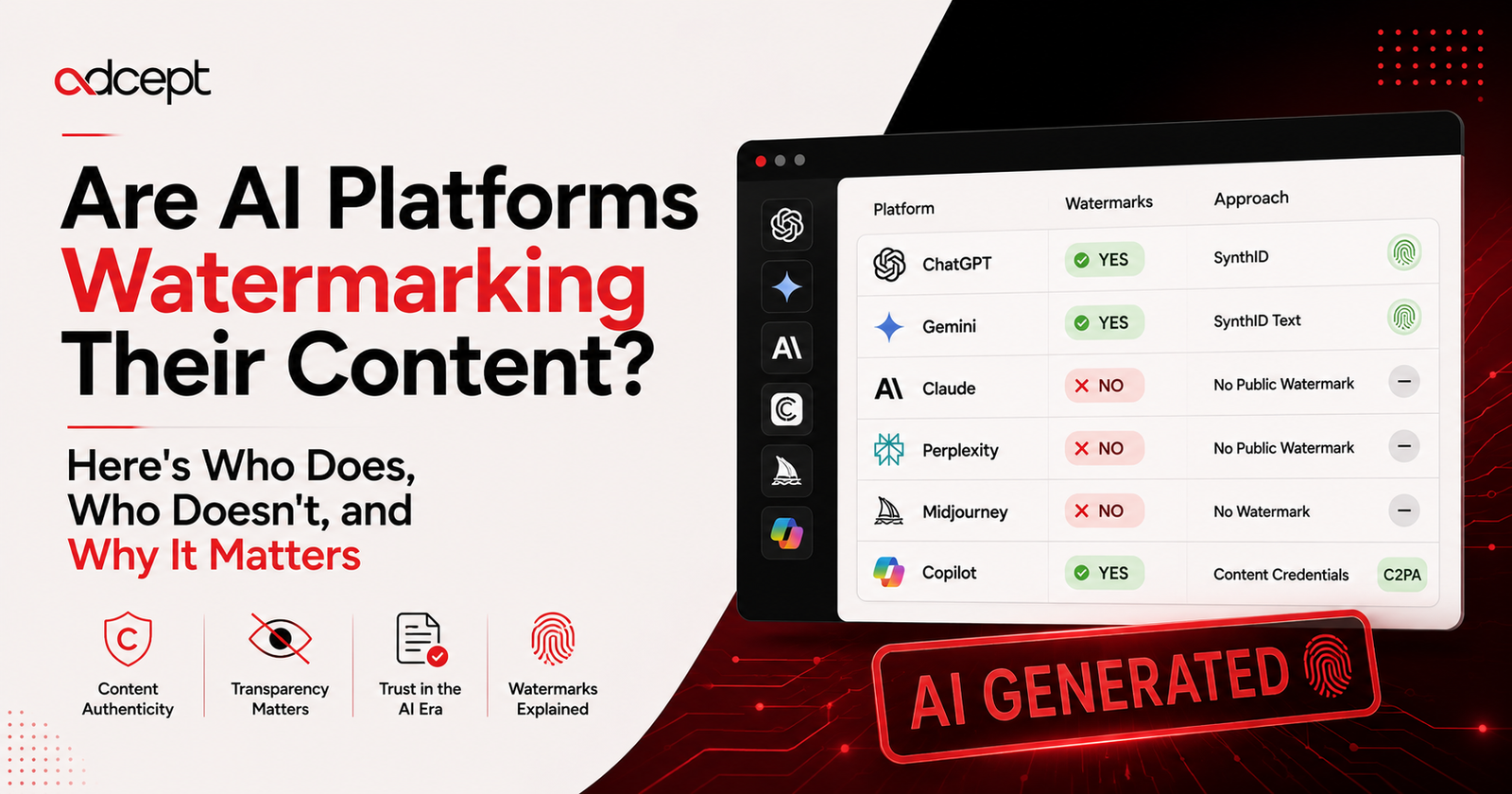
As of 19 August 2026, the direct answer is yes: some AI platforms watermark content, but adoption is uneven. If you are asking whether AI platforms watermark content, the answer depends on the provider, the content type and the product path used to create or export the file.
Google is the furthest along across text, image, audio and video through SynthID. Anthropic has moved to invisible text watermarking for supported Claude models launched from 2 August 2026 onward. OpenAI applies provenance signals to supported images and audio, but there is no confirmed broad ChatGPT text watermark as of this publication date.
This area is moving quickly, so this article should be reviewed regularly.
What Is AI Content Watermarking?
AI content watermarking is a method of adding a hidden or visible signal to AI-generated content so it can later be identified as synthetic or AI-assisted.
The signal may be embedded directly into text, images, audio or video.
It may also appear as metadata attached to a file.
A watermark is not the same as a normal logo or visible label.
Many AI watermarks are invisible to humans and are only detected by software.
What Is the Purpose of AI Watermarking?
AI watermarking helps platforms, publishers, regulators and users identify whether content may have been generated or altered by AI. It is mainly used for provenance, authenticity, trust, misinformation control and regulatory compliance.
It does not prove that the content is true.
It also does not always prove who created it.
It only gives a signal about origin or processing.
Quick Status Table
Here is the practical state of AI content watermarking as of 19 August 2026.
Google DeepMind says SynthID embeds digital watermarks directly into AI-generated images, audio, text or video, while OpenAI says its supported generated images include both C2PA metadata and SynthID watermarks and supported generated audio includes SynthID.
Google: SynthID Across Multiple Content Types
Google is one of the clearest examples of AI content watermarking at scale.
Its SynthID system is designed to watermark and identify AI-generated content.
Google DeepMind says SynthID embeds watermarks into images, audio, text and video, and that SynthID has been expanded to text generated by Gemini.
For detection, Google says Gemini can check whether an uploaded image, video or audio clip was generated or edited by Google AI.
Google also says it has launched a SynthID Detector verification portal and is testing it with journalists and media professionals.
Does Google Watermark Gemini Text?
Yes. Google says SynthID has been expanded to watermark and identify text generated by the Gemini app and web experience. The watermark works by adjusting token probability choices in a way that is not visible to human readers.
This does not mean every piece of text on the internet can be checked by anyone.
Detection access and reliability still depend on tool availability and the content itself.
Anthropic Claude: Invisible Text Watermarks
Anthropic has moved more directly into text watermarking.
Anthropic’s help documentation says Claude models launched in the EU on or after 2 August 2026 will support machine-readable marking at launch, with embedded watermarks for generated text and signed provenance metadata for supported generated files.
Anthropic also says marking applies wherever supported Claude models are offered, worldwide.
That includes Claude products and access through cloud partners, although some marking types may vary by platform or feature.
Does Claude Watermark Text?
Yes, for supported Claude models launched on or after 2 August 2026. Anthropic says the watermark is embedded directly into generated text, travels when copied and pasted, and may survive some editing.
Anthropic also makes an important limitation clear.
A detected Claude mark means the content may have been processed by Claude.
It does not prove full authorship by itself.
This distinction matters for schools, publishers, agencies and legal teams.
A watermark can be evidence.
It should not be treated as a complete judgement on its own.
OpenAI: Images and Audio, but No Broad ChatGPT Text Watermark Yet
OpenAI’s current approach is more layered by media type.
OpenAI says supported images generated with ChatGPT, Codex, and the OpenAI API include both C2PA metadata and SynthID watermarks. It also says supported OpenAI-generated audio includes an inaudible SynthID watermark.
OpenAI also provides OpenAI Verify, which checks supported files for OpenAI provenance signals such as SynthID or a trusted C2PA manifest.
The tool is not designed to detect content from other AI services.
Does ChatGPT Watermark Text?
As of 19 August 2026, OpenAI has not confirmed broad watermarking for ordinary ChatGPT text outputs. Its current help documentation lists images and audio as using provenance signals, and says OpenAI’s goal is to expand provenance signals to all modalities, including text, as standards mature.
OpenAI has also previously discussed why text watermarking is hard.
Its 2024 provenance update said text watermarking can be weakened by methods such as translation or rewording with another model, and raised concerns about false positives at scale and possible stigma for non-native English speakers using AI as a writing tool.
So the practical answer is: ChatGPT text should not be assumed to carry a reliable machine-readable watermark.
Why AI Platforms Are Adding Watermarks
AI platforms are adding watermarks for four main reasons.
1. Provenance and Authenticity
Users, publishers and platforms need better ways to check where content came from.
This is especially important for images, voice, video and public-facing material.
2. Regulatory Pressure
The EU AI Act is a major driver.
European Commission guidance says Article 50 applies from 2 August 2026 and requires providers to add machine-readable marks to enable detection of AI-generated or manipulated content.
The same guidance says the aim is to help people know when they are interacting with AI or exposed to AI-generated content.
3. Trust and Misinformation
AI-generated media is becoming more realistic.
Watermarking is one way to reduce confusion between authentic and synthetic material.
It is especially relevant for news, politics, education, legal evidence, healthcare communication and brand safety.
4. Durability
Platforms are combining watermarking and metadata because each method has weaknesses.
OpenAI explains that C2PA metadata can carry detailed context but may be stripped during uploads, downloads, editing or file conversions. It also says watermarks such as SynthID may be more durable through some transformations but usually carry less context than metadata.
Watermarks vs C2PA Content Credentials
Watermarks and C2PA Content Credentials are related, but they are not the same.
The best approach is usually layered.
A watermark can survive some transformations.
Metadata can explain more about the file’s origin.
Together, they give a stronger provenance signal than either one alone.
Limits of AI Watermark Detection
AI watermarking is useful, but it is not foolproof.
The biggest limits are:
- Not every platform uses watermarks.
- Not every content type is covered.
- Detection tools may be private or provider-locked.
- Metadata can be stripped.
- Watermarks can be degraded through edits.
- Short text may be harder to assess.
- A watermark does not prove legal ownership.
- A watermark does not prove truth or accuracy.
- No signal found does not prove content is human-made.
OpenAI’s help centre says if no signal is detected, the content still could have come from OpenAI if the signal is missing, unsupported, degraded or stripped.
That same logic applies more broadly.
Detection failure is not proof of human authorship.
What Businesses Should Do
Businesses should treat AI watermarking as part of a wider content governance process.
Do not rely on it as the only control.
Practical steps include:
- Keep internal records of AI-assisted work.
- Label AI-generated public content where required.
- Use approved tools for client or sensitive content.
- Avoid uploading confidential data into public systems.
- Store original files where C2PA metadata is preserved.
- Use human review for public, legal, medical or financial material.
- Check EU AI Act exposure if publishing into EU markets.
- Refresh policies as providers update watermarking rules.
Expert Tip
Do not ask “Can this be detected?”
Ask “Can we explain how this content was created?”
That is a stronger standard for agencies, publishers and professional teams.
Quick Summary
AI watermarking is real, but uneven.
Google uses SynthID across several media types.
Anthropic now marks text for supported Claude models launched from 2 August 2026 onward.
OpenAI uses C2PA and SynthID for supported images and SynthID for supported audio, but does not currently confirm broad ChatGPT text watermarking.
Watermarks help, but they do not settle every authorship or trust question.
Conclusion
So, do AI platforms watermark content?
Yes, but not consistently.
Google has the broadest SynthID coverage across text, images, audio and video.
Anthropic has moved into invisible Claude text watermarks and signed file provenance for supported outputs.
OpenAI uses provenance signals for supported images and audio, but everyday ChatGPT text should not be assumed to carry a confirmed watermark as of 19 August 2026.
The reason this matters is simple.
AI content is now part of public communication, marketing, education, media and business operations.
Watermarking can help with trust, provenance and compliance, especially as the EU AI Act pushes providers towards machine-readable marking.
But watermarking is not a magic truth detector.
It is one signal in a larger system of disclosure, recordkeeping, editorial review and responsible AI use.
Key Takeaways
- AI watermarking adoption is real but uneven across providers and content types.
- Google SynthID covers images, audio, text and video across supported Google AI outputs.
- Claude now embeds invisible text watermarks for supported models launched from 2 August 2026 onward.
- OpenAI uses C2PA and SynthID for supported images and SynthID for supported audio.
- There is no confirmed broad ChatGPT text watermark as of 19 August 2026.
- EU AI Act Article 50 is a major driver of machine-readable marking.
- C2PA metadata carries more context but can be stripped more easily.
- Watermarks are useful signals, but they are not foolproof proof of authorship.
FAQs
1. Do AI platforms watermark content?
Yes, some AI platforms watermark content, but coverage varies. Google, Anthropic and OpenAI all use provenance signals in different ways, depending on the content type and product.
2. What is AI content watermarking?
AI content watermarking is the process of embedding a hidden or visible signal into AI-generated content so it can later be identified as synthetic or AI-assisted.
3. Does ChatGPT watermark text?
As of 19 August 2026, there is no confirmed broad watermark for ordinary ChatGPT text. OpenAI currently lists provenance signals for supported images and audio, with plans to expand to more modalities.
4. What is SynthID watermarking?
SynthID is Google DeepMind’s watermarking technology for identifying AI-generated content. It can embed signals into supported images, audio, text and video.
5. What are C2PA Content Credentials?
C2PA Content Credentials are signed metadata that can record provenance information about a file, such as where it came from and how it was created or edited.
6. Can AI watermarks be removed?
Sometimes. Metadata can be stripped through file handling, and watermarks can be degraded by heavy editing, compression or transformation. No method is perfect.
7. Does an AI watermark prove who wrote something?
No. A watermark may show that content was generated or processed by a platform, but it does not always prove full authorship, ownership, truth or intent.
8. Why does the EU AI Act matter for watermarking?
The EU AI Act’s Article 50 transparency rules apply from 2 August 2026 and require machine-readable marking for certain AI-generated or manipulated content where technically feasible.