Skip to content


Learn how to read Google Search Console’s generative AI performance report, track AI Overviews visibility and measure AI traffic in GA4.
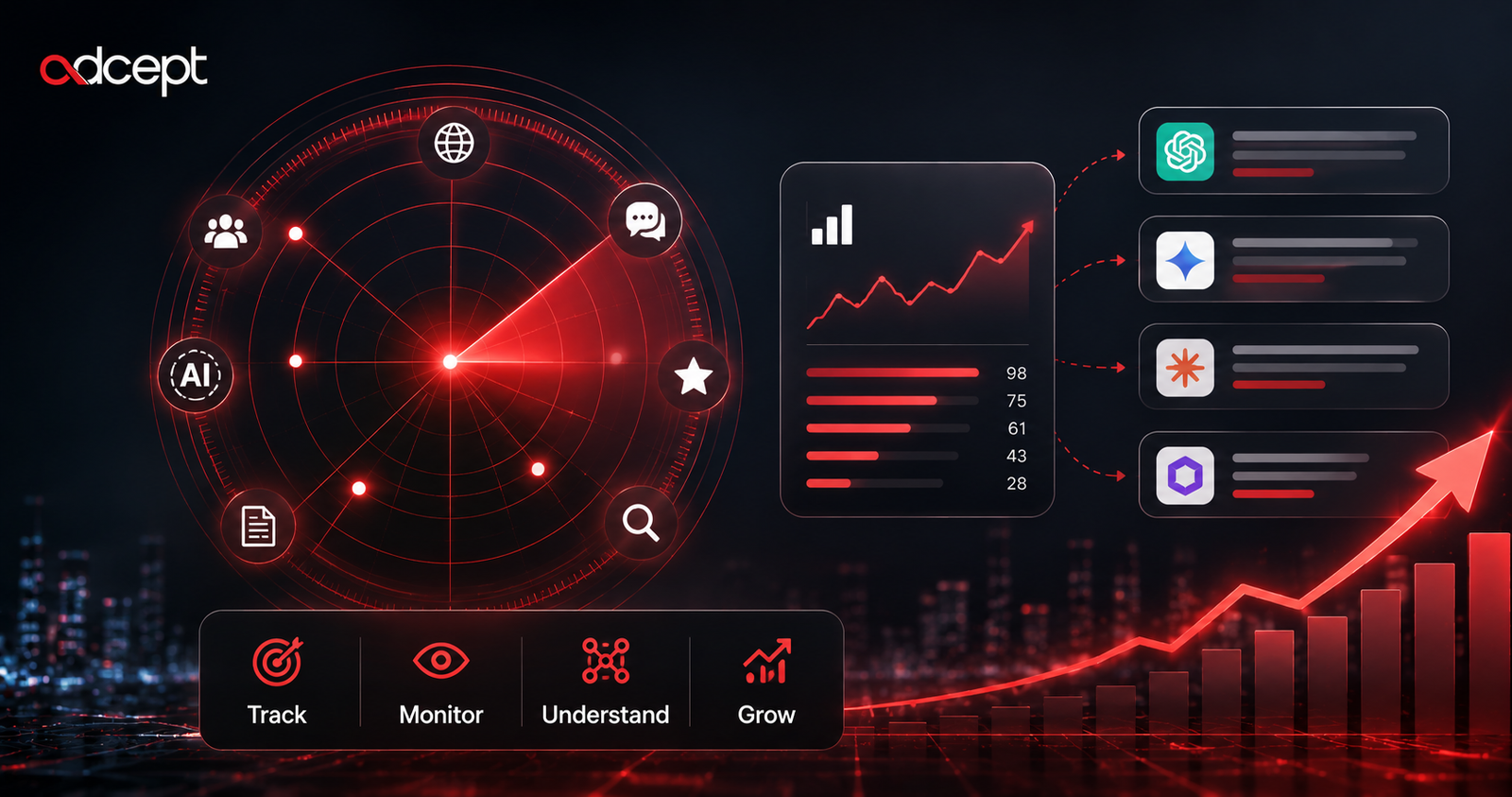
Brand Radar is Ahrefs’ AI visibility and AEO tool for tracking how often a brand appears in AI-generated answers. If you are asking what Brand Radar is, the simple answer is this: it shows where your brand is mentioned, cited, compared and described across AI search platforms such as ChatGPT, Gemini, Perplexity, Copilot and Google AI experiences. Ahrefs says Brand Radar monitors AI visibility across hundreds of millions of search-backed prompts and tracks metrics such as mentions, citations, impressions and AI Share of Voice.
This matters because brand visibility is no longer limited to Google rankings.
People now ask AI tools for product recommendations, vendor comparisons, local business options and “best for” advice.
If those systems do not mention your brand, you may be invisible in a growing layer of search.
What Is Brand Radar?
Brand Radar is Ahrefs’ tool for measuring how brands appear across AI search, traditional search signals and other visibility channels. It tracks brand mentions, cited pages, estimated impressions and share of voice so marketers can see whether AI systems are recommending, referencing or ignoring their brand.
In plain English, Brand Radar helps answer questions like:
- Does ChatGPT mention our brand?
- Does Gemini cite our website?
- Which pages are being cited?
- Which topics are we missing?
- Is AI describing our brand correctly?
- Which third-party pages influence AI answers?
That makes it useful for SEO, brand strategy, PR, content marketing and AEO.
AEO usually means Answer Engine Optimisation, which is the practice of improving visibility inside AI-generated answers.
Why AI Visibility Tracking Matters
AI visibility tracking matters because AI search does not behave like traditional search. A user may never see a ranked list of ten links. Instead, the AI system may summarise options, mention a few brands, cite a handful of sources and guide the user’s next step.
Traditional SEO tools show rankings, clicks and impressions.
AI visibility tools show whether your brand is present in generated answers.
That difference matters for commercial searches such as:
- “best CRM for small agencies”
- “top SEO agencies in Melbourne”
- “which ecommerce email platform should I choose”
- “best accounting software for Australian businesses”
- “compare HubSpot and ActiveCampaign for B2B”
If your competitors appear and you do not, you have an AI visibility gap.
How Brand Radar Works
A simplified process looks like this:
Prompt is run across AI platforms
↓
AI response is stored
↓
Brand mentions are detected
↓
Cited URLs are extracted
↓
Competitors are compared
↓
Share of voice and visibility trends are reported
This is different from checking one prompt manually.
Manual testing is useful, but it is inconsistent and hard to scale.
Brand Radar turns that testing into a repeatable dataset.
Core Brand Radar Reports
Brand Radar is useful because it separates different types of AI visibility.
A mention is not the same as a citation.
A citation is not the same as positive positioning.
A competitor mention is not the same as your own brand visibility.
1. Mention Tracking
Mention tracking shows how often your brand appears in AI responses.
This tells you whether AI systems recognise your brand for a topic.
Ahrefs defines AI Visibility metrics in Brand Radar around mentions, citations, impressions and AI Share of Voice.
Example:
A user asks:
What are the best project management tools for agencies?
If the AI answer mentions Asana, Monday.com and ClickUp but not your tool, you have a mention gap.
2. Citation Tracking
Citation tracking shows whether AI systems link to your website or pages as sources.
This is important because being mentioned is good, but being cited can be stronger.
A cited page may show that your website is being used as supporting evidence.
Ahrefs’ developer documentation also separates page statuses such as cited, found but not cited, and not found, which shows that retrieval and final citation can be different steps.
3. Competitor Benchmarking
Competitor benchmarking compares your visibility against other brands.
This can show whether you are losing visibility on topics that matter.
Ahrefs says Brand Radar can help compare visibility with competitors using metrics such as mentions, citations, impressions and share of voice.
This is useful because AI search is not only about whether you appear.
It is also about who appears instead of you.
4. Narrative and Sentiment Analysis
Narrative analysis asks whether AI systems describe your brand accurately, positively and in the right context.
Ahrefs’ own guidance around AI visibility audits recommends reviewing sentiment and framing, such as whether a brand is presented in a positive, neutral or negative light.
This is more strategic than counting mentions.
For example, it matters whether AI describes your company as:
- a premium option
- a budget option
- a local specialist
- an outdated provider
- a technical leader
- a generic vendor
The narrative can influence perception before a buyer visits your site.
How to Use Brand Radar to Grow Visibility
Brand Radar is most valuable when it becomes an action loop, not just a dashboard.
The goal is not to stare at AI visibility scores.
The goal is to find the gaps and build better assets.
Step 1: Identify Prompts Where You Are Absent
Start with topics where your brand should appear but does not.
Examples:
- service comparisons
- local provider recommendations
- “best tools for” prompts
- “alternatives to” prompts
- industry-specific buying questions
- problem-aware searches
These prompts show where your brand has weak AI visibility.
Step 2: See Who Is Being Mentioned Instead
Next, check which competitors appear.
Look for patterns:
- Are they being cited from their own website?
- Are they being mentioned by third-party articles?
- Are comparison pages driving visibility?
- Are review platforms influencing responses?
- Are Reddit or YouTube results shaping the answer?
Ahrefs says Brand Radar tracks AI visibility alongside wider drivers such as search demand, web visibility, video visibility and social platforms such as YouTube, Reddit and TikTok.
That matters because AI visibility is often influenced by the wider web, not only your own pages.
Step 3: Reverse-Engineer Citation-Worthy Pages
Do not copy competitors.
Study why they are being cited.
Citable pages often have:
- clear definitions
- direct answers
- comparison tables
- original data
- pricing transparency
- FAQs
- strong internal links
- updated information
- trusted third-party mentions
- clear author or brand authority
This is where AI visibility connects back to SEO.
If your page is thin, vague or hard to parse, it is less likely to be useful as a source.
Step 4: Close Content Gaps
Create or improve pages that deserve to be cited.
Good examples include:
- original research
- industry benchmarks
- transparent pricing guides
- comparison pages
- technical explainers
- case studies
- buyer guides
- local service pages
- product use-case pages
The best content for AI search is usually not generic.
It is structured, specific and useful enough to quote.
Step 5: Re-Check Visibility Over Time
AI visibility should be treated as a leading indicator.
It does not map perfectly to Google Search Console rankings or clicks.
But it can show whether your brand is becoming more present in AI-generated discovery.
Track:
- prompts where you appear
- prompts where competitors appear
- citation growth
- sentiment changes
- cited page changes
- topic-level share of voice
- third-party pages influencing answers
This gives you a practical AI search feedback loop.
Brand Radar SEO: What to Measure
Brand Radar SEO is the process of using AI visibility data to improve content, citations, brand mentions and topic authority across generative AI platforms.
These metrics should not replace SEO metrics.
They should sit beside them.
Use Brand Radar with:
- Google Search Console
- analytics data
- CRM lead data
- rank tracking
- content performance
- conversion reporting
AI visibility is only useful if it informs action.
Limitations of AI Visibility Tools
Brand Radar and similar tools are useful, but they are not perfect.
AI answers are non-deterministic.
That means the same prompt may produce different answers or citations at different times.
Ahrefs itself notes that AI answers can change from query to query, and even the same prompt can return different citations.
So treat Brand Radar as a compass, not a precision instrument.
Common limits include:
- AI answers vary between runs.
- Platforms change their models.
- Citations may appear or disappear.
- Prompt databases are modelled, not perfect.
- Visibility does not equal traffic.
- Mentions do not always mean positive positioning.
- AI referral tracking is still developing.
The right question is not, “Is this number exact?”
The better question is, “What direction is our visibility moving, and what should we improve next?”
Alternatives to Brand Radar
Brand Radar is not the only AI visibility tool.
The category is moving quickly.
Semrush has an AI Visibility Toolkit that tracks AI mentions, cited pages and citations across AI-generated search results. Semrush also describes reports for brand visibility, share of voice and sentiment across AI platforms.
Profound tracks AI visibility, share of voice, citation share, sentiment and position across answer engines.
Scrunch tracks brand presence, competitive presence, share of voice, response sentiment, citations, AI referrals and AI search trends.
This is not yet a mature category like rank tracking.
Tools will differ in prompt sets, supported platforms, methodology and reporting style.
For most brands, the important thing is to start measuring.
You cannot improve AI visibility if you have no baseline.
Conclusion
So, what is Brand Radar?
Brand Radar is Ahrefs’ AI visibility tracking tool for understanding where and how your brand appears across AI-generated answers.
It helps marketers track brand mentions, citations, competitor visibility, share of voice and brand narrative across AI search platforms.
The value is not only measurement.
The real value is the action loop.
Find where your brand is missing.
Study who is being cited.
Build better content.
Earn stronger mentions.
Then re-check visibility over time.
As AI search grows, brand visibility will not be measured only by rankings and clicks.
It will also be measured by whether AI systems know, trust, mention and cite your brand.
Key Takeaways
- Brand Radar is Ahrefs’ AI visibility and AEO tracking tool.
- It tracks brand mentions, citations, impressions and AI Share of Voice.
- It can help compare your brand against competitors in AI-generated answers.
- AI visibility is different from traditional Google ranking visibility.
- Mentions show awareness; citations show source usage.
- Sentiment and narrative matter because AI answers shape buyer perception.
- AI visibility tools are directional, not perfect.
- The best use of Brand Radar is to turn visibility gaps into better content and citation opportunities.
FAQs
1. What is Brand Radar?
Brand Radar is Ahrefs’ AI visibility tool. It tracks how brands appear in AI-generated answers, including mentions, citations, impressions and share of voice across supported AI search platforms.
2. What does Ahrefs Brand Radar track?
It tracks brand mentions, cited URLs, estimated impressions, AI Share of Voice and competitor visibility. It can also help show which prompts, platforms and topics include or exclude your brand.
3. How does Brand Radar help SEO?
Brand Radar helps SEO by showing where your brand is visible or missing in AI answers. This can guide content updates, comparison pages, citation-building and topic authority work.
4. Can Brand Radar track brand visibility in ChatGPT?
Yes. Ahrefs says Brand Radar and its AI visibility tools track brand mentions across platforms including ChatGPT, Gemini, Perplexity, Copilot and Google AI experiences.
5. What is AI citation tracking?
AI citation tracking shows which pages AI systems cite as sources in generated answers. This helps identify whether your own content or third-party pages are influencing AI responses.
6. Is Brand Radar the same as rank tracking?
No. Rank tracking measures where pages appear in search results. Brand Radar measures whether brands are mentioned or cited inside AI-generated answers.
7. Are AI visibility tools accurate?
They are useful but not exact. AI responses can vary between runs, platforms and time periods. Treat the data as directional rather than a perfect measurement.
8. What are alternatives to Brand Radar?
Alternatives include Semrush AI Visibility Toolkit, Profound and Scrunch. Each tool has its own methodology, supported platforms and reporting features.