Skip to content


Learn how to read Google Search Console’s generative AI performance report, track AI Overviews visibility and measure AI traffic in GA4.
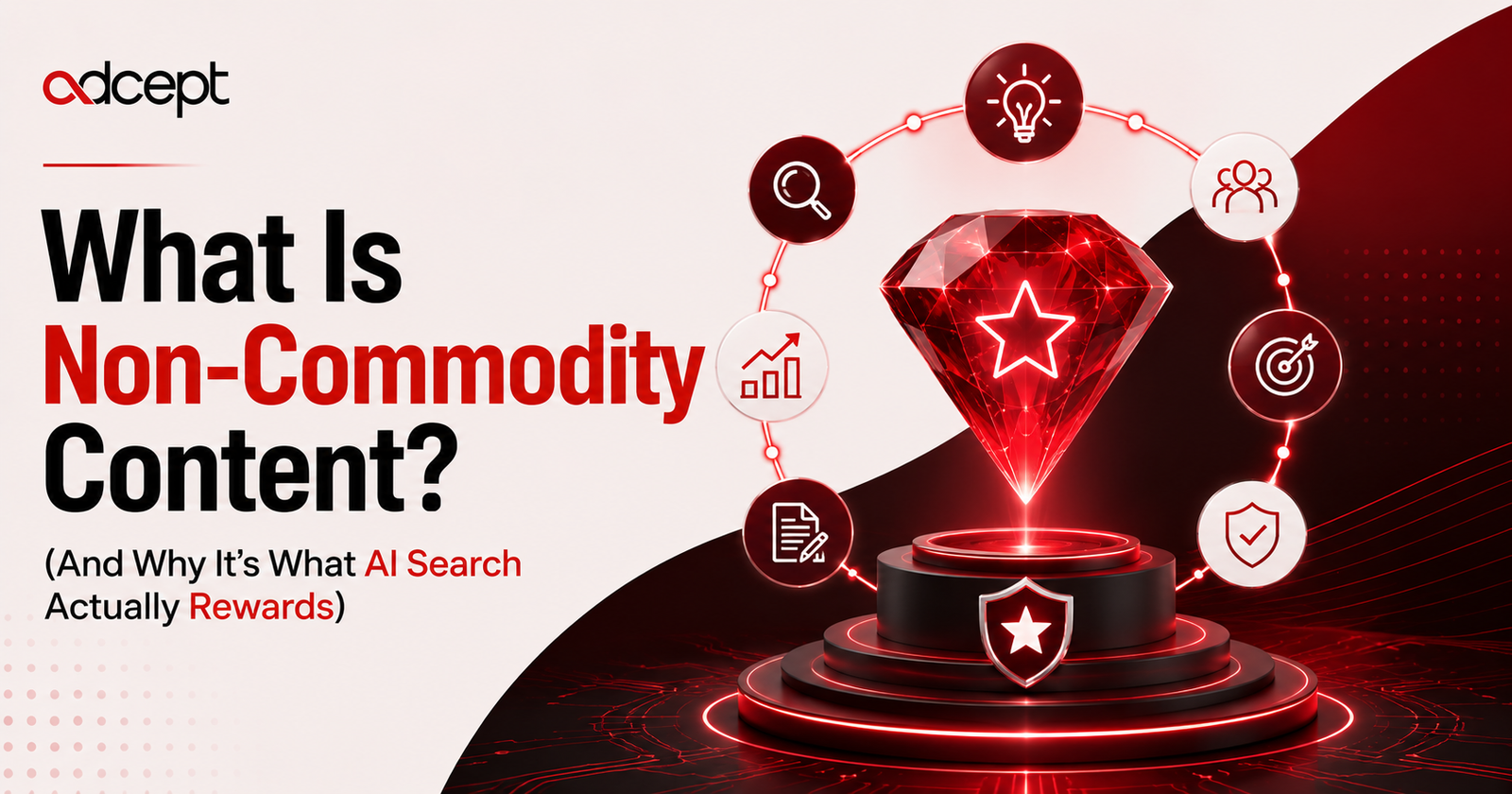
Non-commodity content is content that brings something original to the search result. It does not just answer a question that has already been answered the same way across hundreds of websites. It adds first-hand experience, proprietary data, a strong opinion, a practical framework, real examples, or a useful synthesis that another page cannot easily copy.
This distinction matters more now because AI-powered search can already produce basic answers.
Google says its AI search best practices still rely on strong SEO foundations, but it also specifically points site owners towards creating “non-commodity content” that is helpful, reliable and people-first.
That is a big shift.
It means the old content calendar built around generic “what is” posts and basic how-to blogs needs a harder filter.
What Is Non-Commodity Content?
Non-commodity content is content with a unique value that cannot be easily recreated by summarising existing pages. It may include original research, real client examples, tested workflows, expert judgement, proprietary data, screenshots, templates, frameworks, or a clear point of view.
A normal article may explain a topic.
A non-commodity article teaches, proves, challenges, demonstrates or reveals something.
For example, “What is local SEO?” is usually commodity content.
“How we diagnose local SEO problems for multi-location clinics” is much closer to non-commodity content.
The first answers a common definition.
The second shows process, experience and context.
Commodity vs Non-Commodity Content
The difference between commodity and non-commodity content is not always binary. It is better to think of it as a spectrum.
Some pages are fully generic.
Some are partly useful but still easy to copy.
Some are genuinely differentiated.
What Is Commodity Content?
Commodity content is content that answers a common question in the same way as many other pages. It may be accurate, but it has no original angle, experience, data, examples or decision-making value.
Common commodity formats include:
- Basic definitions
- Generic benefits lists
- Simple “how to” posts
- Shallow comparison tables
- Glossary-style articles
- Rewritten competitor posts
- AI-generated summaries with no added insight
Commodity content is not always useless.
But it is rarely where serious content budgets should go.
Why AI Search Rewards Non-Commodity Content
AI search rewards non-commodity content because AI systems can already generate basic answers from common knowledge. What they still need are reliable sources with original value, clear expertise, real examples and trustworthy context.
Google’s guidance says AI features in Search still rely on foundational SEO practices, including technical access, Search policies and helpful, reliable, people-first content.
Perplexity describes itself as an answer engine that searches the web, identifies trusted sources and synthesises information into answers.
That means source quality matters.
If your page only says what every other page says, an AI system may not need it.
If your page contains original data, a strong framework, fresh examples or first-hand analysis, it gives the system something harder to reconstruct.
Why Non-Commodity Content Matters for SEO
Non-commodity content matters for SEO because it gives search engines, AI answer engines and human readers a reason to choose your page. It supports topical authority, improves trust, attracts better links and makes the brand look like an expert rather than a content factory.
This is especially important in crowded markets.
If ten agencies publish “What is content marketing?”, the user has no reason to remember any of them.
If one agency publishes “Why most B2B content calendars fail after month three, based on 40 content audits”, that page has a stronger reason to exist.
Examples of Commodity and Non-Commodity Content
The easiest way to understand this idea is through examples.
Example 1: SEO
Commodity version:
What is technical SEO?
Non-commodity version:
The 17 technical SEO issues we check before approving a website migration.
The second version shows process.
It also attracts a more serious reader.
Example 2: Email Marketing
Commodity version:
Benefits of email marketing.
Non-commodity version:
The three email flows we build first for service businesses with long sales cycles.
The second version is more useful because it shows priority and context.
Example 3: AI Search
Commodity version:
How AI is changing SEO.
Non-commodity version:
AI Overviews killed these keyword types, so we stopped prioritising them.
The second version has an opinion.
It gives the reader a sharper strategic lesson.
Example 4: Content Strategy
Commodity version:
Content marketing strategy guide.
Non-commodity version:
How we decide whether a blog topic is worth writing before it enters the content calendar.
The second version shows an operating system.
That is what clients and readers remember.
The Non-Commodity Content Audit Framework
Before writing any article, ask these five questions.
1. Can AI already answer this in 60 seconds?
If the answer is yes, the topic needs a stronger angle.
Basic explanations are easy for AI Overviews, ChatGPT, Gemini and Perplexity to summarise.
That does not mean you cannot cover the topic.
It means you should not stop at the basic answer.
2. What can we add that competitors cannot?
This is the most important question.
Possible answers include:
- Internal data
- Client patterns
- A pricing framework
- A technical workflow
- Screenshots
- Templates
- Original diagrams
- Anonymised examples
- Strong editorial judgement
- Local market context
If you cannot add anything unique, the content is probably too generic.
3. Does the topic support a business goal?
A high-volume keyword is not always a high-value keyword.
Ask whether the article supports:
- Service positioning
- Lead generation
- Sales education
- Internal linking
- Topical authority
- Brand trust
- Decision-making
If it does none of these, it may not deserve budget.
4. Is there a clear next step for the reader?
Good content should move the reader somewhere useful.
That next step could be:
- Read a service page
- Download a checklist
- Compare options
- Request an audit
- Review a case study
- Use a template
- Read a deeper guide
Non-commodity content does not need to be salesy.
But it should not be a dead end.
5. Would this still be useful without Google traffic?
This question forces honesty.
If the article would still be useful in a sales call, onboarding email, proposal, webinar or client education pack, it is probably worth creating.
If it only exists to catch a keyword, it may be commodity content.
Where Commodity Content Still Has a Role
Commodity content is not always bad.
It still has a role when used carefully.
For example, commodity-style sections can help:
- Define basic terms
- Capture low-effort long-tail queries
- Support pillar pages
- Build glossary coverage
- Help beginner readers
- Create internal linking paths
- Answer FAQs
- Clarify product or service language
The mistake is not publishing any commodity content.
The mistake is making it the centre of the strategy.
A content plan full of generic definitions will struggle to earn trust.
A content plan with strong non-commodity assets supported by simple explanatory content is much healthier.
How This Changes Content Calendars
Non-commodity content changes the content calendar from a publishing schedule into a strategic roadmap.
Instead of asking, “What keywords can we write about this month?”
Ask:
- What do we need to be known for?
- What buyer questions block sales?
- What proof can we show?
- What process can we reveal?
- What opinion do we believe?
- What client pattern have we seen repeatedly?
- What would help a serious buyer make a better decision?
This changes the type of articles that get approved.
Old Content Calendar
- What is SEO?
- Benefits of SEO
- SEO vs Google Ads
- How to write a blog
- Why content marketing matters
Better Content Calendar
- Why generic SEO retainers fail for local service businesses
- How we audit content before rewriting a website
- The search intent mistakes we see in service pages
- What we remove from SEO reports because clients do not need it
- The content assets that actually support sales calls
The second list is harder to write.
That is exactly why it is stronger.
Common Mistakes
Mistake 1: Treating Content as Word Count
A 2,000-word article can still be thin if it says nothing new.
Depth is not only length.
Depth is usefulness, specificity and judgement.
Mistake 2: Confusing Original Wording With Original Thinking
Rewriting the same advice in different words is not differentiation.
Original content SEO needs original value.
That may come from data, examples, process, comparison, critique or synthesis.
Mistake 3: Publishing Without a Point of View
Neutral content is safe, but often forgettable.
A strong point of view helps readers understand how you think.
It also separates expert content from generic content.
Mistake 4: Ignoring First-Hand Experience
Google’s helpful content guidance encourages creators to ask whether content shows first-hand expertise and depth of knowledge.
That matters because real experience is difficult to fake.
Use what your team has actually seen, built, tested or learned.
Mistake 5: Making Every Article a Sales Page
Non-commodity content is not the same as promotional content.
The best content teaches first.
The commercial value comes from trust.
Conclusion
Non-commodity content is the future of serious content strategy because AI search has made generic answers easier to produce and easier to ignore.
The split between commodity and non-commodity content is not absolute.
Some basic content still has a role.
But the budget, strategy and senior thinking should go into assets that bring something new to the page.
That might be proprietary data, first-hand experience, a contrarian take, a practical framework, local context or original synthesis.
In a search world shaped by AI Overviews, ChatGPT, Gemini and Perplexity, content needs a reason to be cited, remembered and trusted.
The simple test is this:
If your page can be recreated from the top ten search results, it is commodity content.
If it contains something only your team could produce, it is moving in the right direction.
Key Takeaways
- Non-commodity content adds original value that other pages cannot easily copy.
- Commodity content answers common questions in predictable ways.
- The split is a spectrum, not a strict binary.
- AI search reduces the value of basic, generic informational content.
- Strong content may include data, examples, frameworks, process or opinion.
- Commodity content can still support definitions, FAQs and internal links.
- Content calendars should prioritise differentiated assets.
- The best audit question is: “What can we add that competitors cannot?”
FAQs
1. What is non-commodity content?
Non-commodity content is content that adds unique value through first-hand experience, proprietary data, original frameworks, examples, strong opinions or useful synthesis that competitors cannot easily copy.
2. What is the difference between commodity and non-commodity content?
Commodity content commonly gives common answers. Non-commodity content adds something original, such as real examples, data, process detail, expert judgement or a unique strategic angle.
3. Why does non-commodity content matter for SEO?
It matters because AI search and traditional search both need helpful, reliable sources. Generic content is easier to summarise, while original content gives search systems and readers a stronger reason to trust and cite the page.
4. Is commodity content always bad?
No. Commodity content can still help with definitions, FAQs, beginner education and internal linking. It becomes a problem when it takes most of the content budget.
5. What are examples of non-commodity content?
Examples include original research, anonymised client examples, pricing breakdowns, technical build-logs, strategy frameworks, industry-specific guides, templates and opinion pieces backed by experience.
6. How do I audit a content idea?
Ask whether AI can already answer it, what you can add that competitors cannot, whether it supports a business goal, what the reader should do next and whether it would still be useful without search traffic.
7. How does AI search affect content strategy?
AI search makes basic answers easier to generate, so content needs more differentiation. Pages with original insight, clear structure, proof and experience are more likely to stand out.
8. Should content calendars change because of AI?
Yes. Content calendars should focus less on publishing volume and more on strategic assets that build trust, support buying decisions and show expertise.