Skip to content


Learn how to read Google Search Console’s generative AI performance report, track AI Overviews visibility and measure AI traffic in GA4.
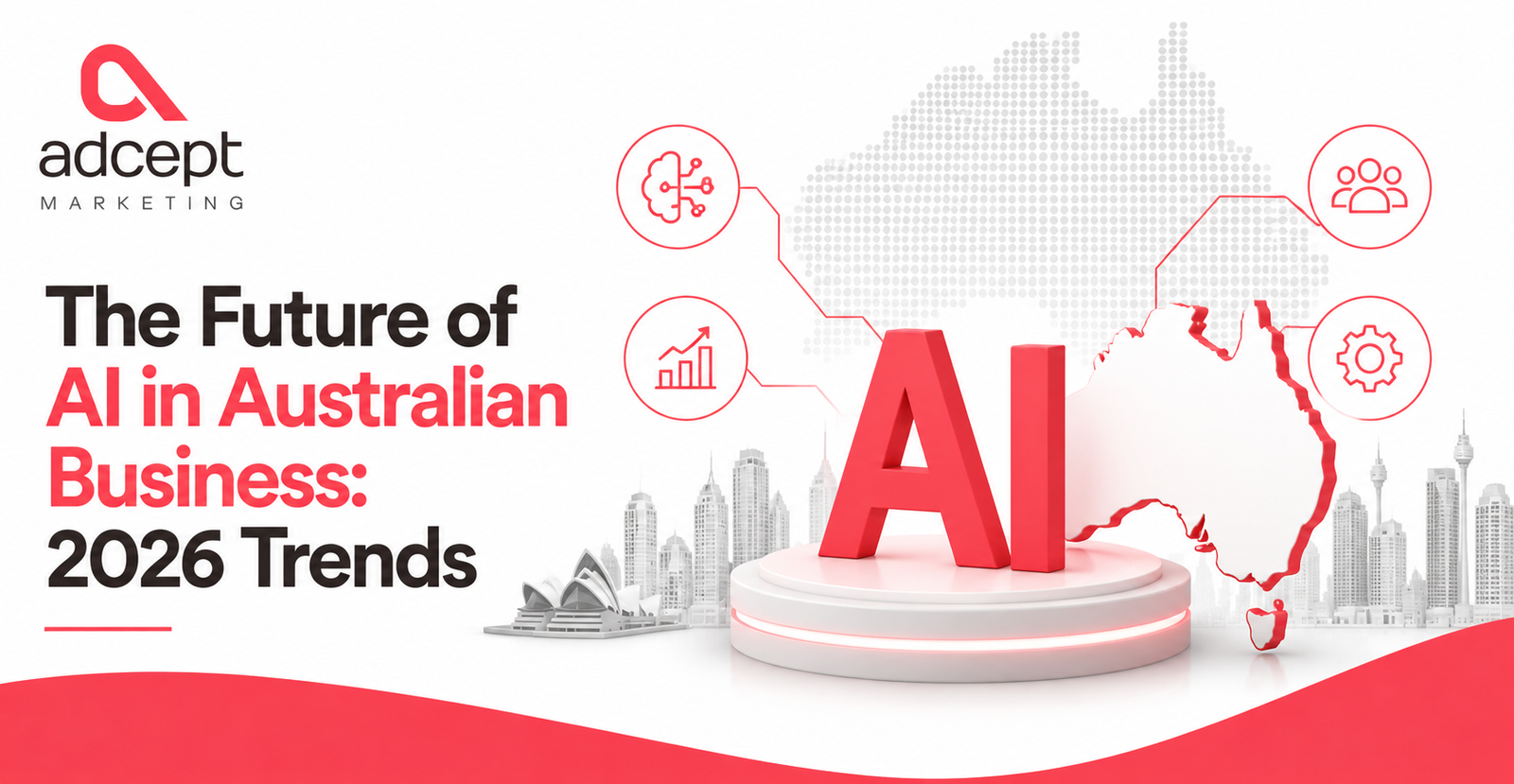
As we look ahead to 2026 and beyond, artificial intelligence (AI) is poised to redefine how Australian businesses operate. No longer just a buzzword, AI is evolving into a powerful tool that drives automation, optimises workflows, and creates new growth opportunities. For Australian business leaders, the future of AI isn’t about waiting for technology to catch up, but about acting now to build the infrastructure needed to stay ahead of the curve.
The businesses that will thrive in the coming years are those that embrace AI automation today, understand its potential, integrating it into their operations, positioning themselves as leaders in their respective industries. In this article, we’ll explore the key AI trends shaping the future of Australian business, and how AI will change everything from customer service to marketing, business strategy, and beyond.
Key AI Trends to Watch in Australian Business in 2026
The AI landscape is evolving rapidly, and several key trends are emerging as the technologies that will shape Australian businesses in 2026. Understanding these trends will help you future-proof your organisation and gain a competitive advantage.
1. Agentic AI: Autonomous Task Execution
One of the most exciting developments in AI is the emergence of agentic AI, systems that can autonomously plan and execute multi-step tasks. Unlike traditional automation, which follows predefined rules, agentic AI can understand the goal of a task, make decisions, and take action without requiring step-by-step instructions.
For Australian businesses, this means the ability to automate complex workflows that were once reliant on human decision-making. From research agents that synthesise market intelligence, to content agents that create and publish content on schedule, agentic AI will significantly reduce manual effort while increasing operational efficiency.
- Example: An agentic AI might autonomously handle a complete customer service flow, from identifying an issue through to resolution and follow-up, without the need for human intervention unless it reaches a more complex stage.
In 2026, agentic AI will be deployed across industries like customer support, sales, and marketing, enabling businesses to scale operations while maintaining high levels of service and personalisation.
2. Multimodal AI Integration
In the future, AI systems won’t just work with text, but will integrate multimodal capabilities, combining text, voice, images, and video into unified workflows. This multimodal integration is already beginning to take shape, with AI capable of processing and responding to inputs in multiple formats, such as voice commands, written text, and visual data.
For Australian businesses, this trend will allow for seamless customer interactions across channels. AI will be able to understand and process voice calls, interpret customer-uploaded images, and read or generate text in real-time, all within the same workflow. This kind of integration will not only enhance customer experiences but also streamline operations, reducing the friction between different communication channels.
- Example: A customer might call your service centre, upload an image of a faulty product via SMS, and receive a real-time text-based response from AI, guiding them through troubleshooting steps, or even automatically scheduling a repair.
3. AI-Powered Search Optimisation (GEO)
As AI-driven search engines become more sophisticated, AI-powered search optimisation (GEO) will become the new frontier of SEO. In the coming years, the way your business is ranked on search engines like Google will be influenced not only by traditional SEO practices but also by how well your content is integrated with AI systems like ChatGPT, Bing AI, and Google’s AI Mode.
This trend will fundamentally change how businesses approach SEO. Instead of just focusing on keywords, businesses will need to optimise their content to be easily indexed and referenced by AI search engines, ensuring that their brand is visible when AI systems generate search results or offer recommendations.
- Example: In 2026, the AI that powers Google Search and ChatGPT will rely heavily on contextual, conversational queries. Businesses that optimise their content for AI-assisted search engines will dominate the digital landscape by appearing in AI-generated responses and featured snippets.
4. No-Code AI Platforms and Democratisation of AI
AI is becoming more accessible than ever, especially with the rise of no-code platforms that allow businesses to build AI applications without needing a team of data scientists. These platforms enable Australian SMEs to integrate AI-powered automation into their operations without technical barriers.
No-code AI tools like Make, n8n, and Zapier allow businesses to automate workflows, integrate AI into customer interactions, and analyse data more efficiently, all without writing a single line of code. As the democratisation of AI continues, businesses of all sizes will be able to take advantage of these powerful tools.
- Example: A small Australian retailer could use a no-code AI platform to automatically classify customer inquiries and route them to the appropriate department, all while integrating AI chatbots for instant responses.
The Role of AI in Customer Experience: A Game-Changer for Australian Businesses
Customer experience (CX) is rapidly becoming the defining factor in business success, and AI is playing a central role in enhancing every aspect of the customer journey. By 2026, businesses will rely heavily on AI to manage and personalise customer interactions at every touchpoint.
1. AI in Customer Service
AI-powered chatbots and virtual assistants are already improving customer service in Australia. These systems can handle routine queries, freeing up human agents to deal with more complex issues. The result is faster response times, reduced wait times, and increased customer satisfaction.
- Example: An AI-powered chatbot might handle the initial stages of a support call, answer frequently asked questions, and escalate only the most complex issues to human agents.
2. AI for Personalised Marketing
AI can personalise marketing messages based on user data and behaviour. By 2026, this capability will become even more sophisticated, with AI systems able to create dynamic content that adapts to the individual preferences and behaviours of each customer.
- Example: An Australian online retailer could use AI to send personalised emails based on a customer’s browsing history, offering product recommendations and discounts tailored to their interests.
Preparing for the Future of AI
AI is not just a future consideration; it’s something businesses should start integrating today. Here’s how you can prepare your business for the AI revolution in 2026:
1. Invest in AI Literacy
Ensure that your leadership team is well-versed in AI concepts, so they can make informed decisions about where and how to implement AI within the business.
2. Start with Small AI Projects
Start with a single AI automation project that addresses a pain point within your business. This could be an AI-powered customer service solution or an automated lead qualification system.
3. Choose the Right AI Partner
Work with an AI specialist or consultancy to help implement your AI systems. A partner like Adcept can guide you through the process of selecting the right tools, integrating AI into your workflows, and scaling your AI capabilities.
Conclusion
The future of AI in Australian businesses is bright, with transformative trends like agentic AI, multimodal integration, and AI-powered search optimisation set to reshape industries in 2026 and beyond. The businesses that act now, building their AI capabilities and integrating automation into their workflows, will have a competitive edge over those that wait.
AI is not just about technology; it’s about changing how businesses operate, making processes smarter, more efficient, and more customer-centric. By staying ahead of these trends, Australian businesses can position themselves for success in an increasingly AI-driven world.
At Adcept, we help businesses embrace AI and implement AI-powered automation solutions that drive real growth. Get in touch today to explore how AI can transform your business.
Key Takeaways
- Agentic AI: Autonomous systems that plan and execute tasks are transforming how businesses handle workflows.
- Multimodal AI: The integration of text, voice, and image processing into unified workflows is enhancing customer interactions.
- AI-Powered Search Optimisation: Optimising content for AI-driven search engines is critical for future success in digital marketing.
- No-Code AI Platforms: No-code platforms are making AI accessible to businesses of all sizes, enabling more widespread adoption.
FAQs
Q: What AI trends should Australian businesses prepare for in 2026?
Key trends include agentic AI (autonomous task execution), multimodal AI integration, AI-powered search visibility, and the democratisation of AI application development through no-code platforms.
Q: Will AI automation replace jobs in Australian businesses?
AI automation is augmenting jobs, not replacing them. While it can handle repetitive tasks, the roles that require creativity, decision-making, and relationship management will continue to grow in value.
Q: How do I ensure my business does not get left behind by AI advancements?
Start by building AI literacy in your leadership team, and implement small, manageable AI projects to gain experience. Regularly review your AI strategy to ensure you’re staying ahead of the competition.