Skip to content


Learn how to read Google Search Console’s generative AI performance report, track AI Overviews visibility and measure AI traffic in GA4.
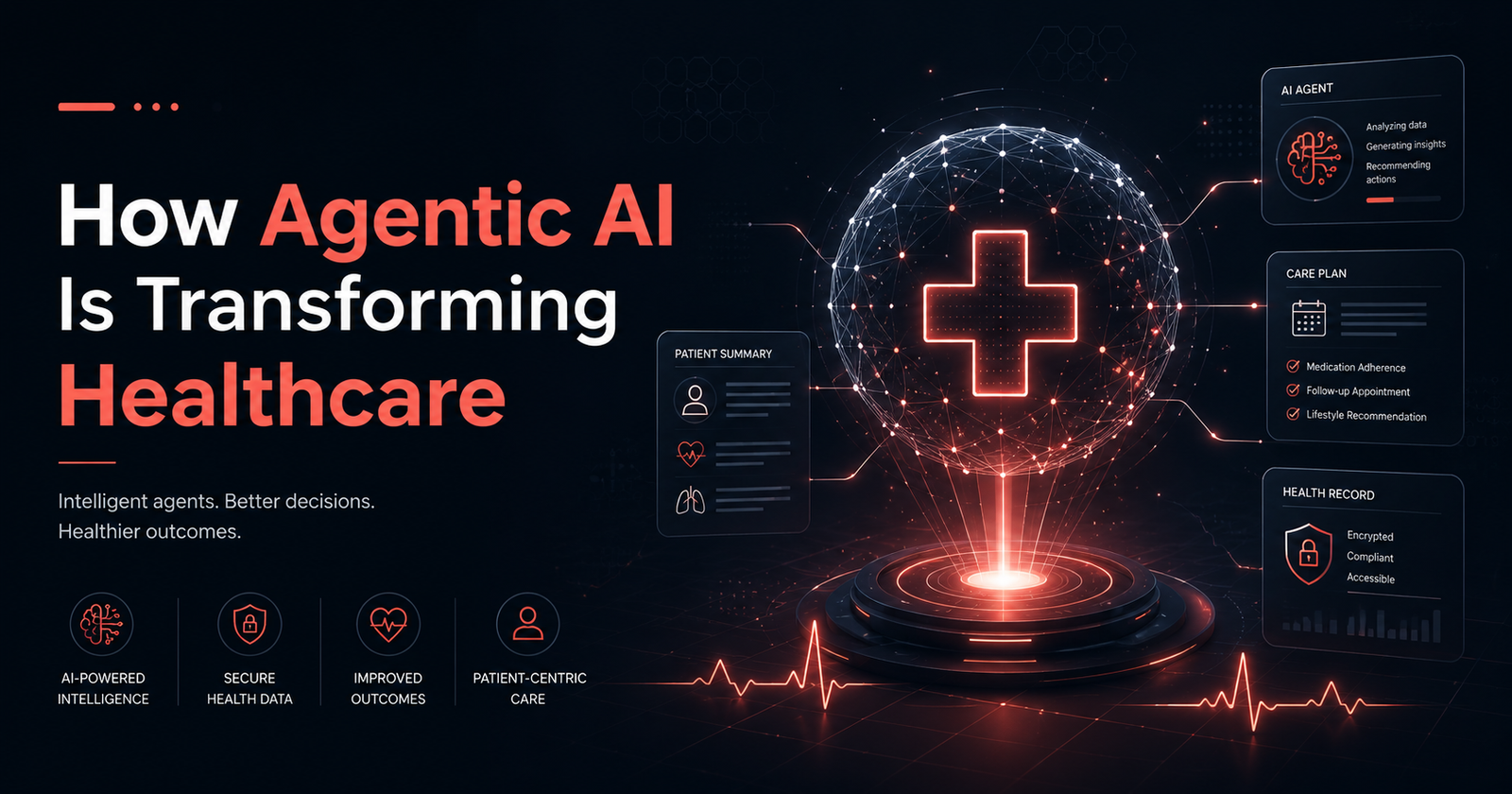
Agentic AI healthcare refers to AI systems that can plan, reason, use tools and complete healthcare workflows with defined human oversight. Unlike a basic chatbot, an AI agent can help triage admin tasks, retrieve patient-related information, draft notes, route requests and trigger workflows across approved healthcare systems.
This article is part of Adcept’s agentic AI content cluster. For the broader concept, start with what is agentic AI, then read the supporting guide on agentic AI architecture.
In healthcare, the opportunity is real, but so is the responsibility.
Patient privacy, clinical safety, consent, auditability and professional accountability must be built into every workflow.
What Is Agentic AI Healthcare?
Agentic AI healthcare is the use of AI agents to support healthcare workflows by understanding a goal, planning steps, using approved tools and completing tasks under human control.
For example, a clinic may use an AI agent to review appointment requests, check intake form completeness, draft a patient follow-up message and flag urgent admin issues to staff.
The key point is control.
Agentic AI should support healthcare teams, not replace clinical judgement.
Ahpra states that practitioners remain responsible for safe and quality care when using AI, and must apply human judgement to AI outputs.
Agentic AI Healthcare in Simple Terms
Agentic AI healthcare means using AI agents as controlled digital assistants for healthcare operations. They can help with admin, documentation, patient communication, scheduling, reporting and workflow routing, while clinicians and authorised staff remain responsible for decisions.
A safe healthcare agent should have:
- Clear permissions
- Human approval points
- Secure data handling
- Audit logs
- Defined use cases
- Privacy controls
- Escalation rules
Why Agentic AI Matters in Healthcare
Agentic AI matters in healthcare because many clinics and care providers are under pressure from admin workload, rising patient expectations and disconnected systems.
Healthcare teams often spend time on:
- Appointment requests
- Intake forms
- Patient reminders
- Follow-up messages
- Referral handling
- Documentation
- Billing admin
- Reporting
- Inbox triage
- Data entry
These tasks are important, but many are repetitive.
Agentic AI can help reduce this burden by automating structured steps while keeping humans involved where judgement is needed.
This is where Healthcare AI Solutions can support clinics, allied health providers and healthcare service teams with practical automation design.
How Agentic AI Works in Healthcare
Agentic AI works by combining a language model, workflow logic, memory, integrations, tool calling and monitoring.
A simple healthcare workflow may look like this:
The AI agent does not need to diagnose or make clinical decisions to be useful.
Many valuable healthcare automations sit in the operational layer.
Core Components
For a more detailed technical breakdown, see Adcept’s article on AI agents explained.
Agentic AI Healthcare Use Cases
Agentic AI healthcare works best when the task is repetitive, rule-based enough to control, and important enough to improve.
It is especially useful for operational workflows, not unsupervised clinical decision-making.
-
Appointment Triage
An AI agent can read appointment requests and classify them by service type, urgency, location, practitioner or missing information.
It can then:
- Route the request to the right team
- Ask for missing details
- Create a booking task
- Send a draft confirmation
- Flag urgent wording for human review
This helps reception teams respond faster.
-
Patient Intake Support
Patient intake forms are often incomplete.
An agent can check whether required fields are missing and send a polite request for completion.
It can also prepare a clean summary for staff before the appointment.
-
Clinical Documentation Support
AI scribes and note assistants can help draft consultation notes from approved inputs.
However, clinicians must review and correct the output.
The TGA advises health professionals to understand the purpose, limitations and appropriate use of software as a medical device, including AI-enabled tools.
-
Follow-Up Reminders
Agentic AI can help manage follow-up workflows.
Examples include:
- Missed appointment follow-ups
- Post-visit instructions
- Referral reminders
- Pathology follow-up prompts
- Recall list preparation
These workflows should follow clinic policy and privacy requirements.
-
Referral and Document Handling
An AI agent can review incoming referral documents, extract key admin details and route them to the right queue.
It can also flag missing attachments or incomplete information.
Human staff should review anything clinical or unclear.
-
Healthcare Inbox Triage
Many clinics receive mixed inbox messages.
Agentic AI can sort messages into categories such as:
- Appointment request
- Billing question
- Referral update
- General enquiry
- Prescription request
- Complaint
- Urgent wording
This can reduce manual sorting and lower the chance of missed messages.
-
Reporting and Admin Workflows
Healthcare managers often need weekly operational reports.
AI agents can help collect information from approved systems, summarise trends and prepare internal updates.
This connects naturally with broader AI Automation Services for reporting, reminders, CRM updates and workflow automation.
Compliance and Safety Considerations
Compliance is central to agentic AI healthcare.
Health information is sensitive information under Australian privacy law, and the OAIC says the Privacy Act applies to all uses of AI involving personal information.
Privacy and Consent
Healthcare AI workflows should clearly manage:
- What data is collected
- Why is it collected
- Where is it stored
- Who can access it
- Whether it is used for AI processing
- How long is it retained
- Whether patient consent is needed
The OAIC also advises organisations to conduct due diligence before adopting AI products and to review performance, staff training and monitoring across the AI product lifecycle.
TGA Regulation
Not every healthcare AI workflow is a medical device.
For example, software used only for scheduling or telehealth delivery may not be regulated as a medical device.
However, the TGA states that software or AI products can be medical devices if they meet the medical device definition, including uses such as diagnosis, monitoring, prediction, prognosis or treatment.
This is important.
A clinic admin agent is different from an AI tool that recommends treatment.
Professional Accountability
Ahpra’s guidance makes it clear that practitioners must understand enough about an AI tool to use it safely and must apply human judgement to AI outputs.
Healthcare organisations should document:
- Intended use
- Known limitations
- Staff responsibilities
- Approval points
- Patient communication rules
- Escalation process
Benefits of Agentic AI Healthcare
The benefits of agentic AI healthcare are strongest in admin-heavy workflows where speed, consistency and accuracy matter.
Key benefits include:
- Less manual admin
- Faster patient response
- Better intake completeness
- Improved follow-up consistency
- Cleaner operational data
- Better task routing
- Reduced staff pressure
- More reliable internal reporting
Challenges of Agentic AI Healthcare
The main challenge is not the AI model.
It is a safe implementation.
Common challenges include:
- Privacy risks
- Poor source data
- Unclear consent
- Weak access controls
- Incomplete monitoring
- Over-automation
- Staff confusion
- Lack of clinical review
A good system should make responsibilities clearer, not blur them.
Real Business Example
A busy allied health clinic receives appointment requests from its website, phone notes and email.
Before automation, reception staff manually reviewed each request, checked practitioner availability, checked for missing details and updated the practice system.
With agentic AI healthcare automation, the clinic can set up an agent to:
- Read the enquiry
- Identify the requested service
- Check whether required intake fields are complete
- Create a task for reception
- Draft a patient response
- Flag urgent wording
- Log the action
- Wait for staff approval before sending
The AI does not provide clinical advice.
It organises the workflow so staff can respond with less manual effort.
This is also where Adcept’s guide on AI agents reducing admin burden for healthcare clinics fits naturally within the cluster.
Best Practices for Agentic AI Healthcare
The safest agentic AI healthcare systems start with low-risk workflows, clear human approval, secure data handling and strong monitoring.
Use these best practices:
- Start with admin, not diagnosis. Begin with booking, intake, reminders, triage and reporting.
- Map the workflow first. Document every step before adding AI.
- Use approved knowledge sources. Keep policy documents, FAQs and templates current.
- Limit data access. Give the agent only the information it needs.
- Add human approval. Require review for sensitive communication or clinical content.
- Keep audit logs. Track actions, outputs, approvals and errors.
- Train staff. Make sure users understand the tool’s limits.
- Review regularly. Check performance, privacy settings and patient feedback.
Expert Tip
Do not start with the most complex clinical use case.
Start with a workflow that staff already understand and can easily check.
Appointment intake, inbox triage and follow-up reminders are safer starting points than clinical recommendations.
Common Mistakes
Mistake 1: Using Public AI Tools With Patient Data
Avoid entering sensitive health information into public AI tools without proper privacy, security and contractual controls.
OAIC guidance warns organisations to take a cautious approach when AI involves personal information, especially where there may be a high privacy risk.
Mistake 2: Removing Human Review
Healthcare needs accountability.
AI-generated summaries, responses or suggested actions should be reviewed where risk is present.
Mistake 3: Confusing Admin Automation With Clinical AI
A reminder workflow is not the same as a diagnostic tool.
The regulatory and safety expectations may be very different.
Mistake 4: No Clear Escalation Path
An AI agent should know when to stop.
Urgent wording, complaints, clinical uncertainty or missing data should be escalated to staff.
Mistake 5: Poor Integration Design
Disconnected systems create errors.
Agentic AI healthcare workflows should connect cleanly with the tools staff already use.
For many clinics, this may include practice management software, CRM tools, inboxes, calendars and internal task systems.
Future Trends
Agentic AI healthcare is likely to grow in areas that reduce admin burden and improve operational visibility.
Future trends include:
- AI reception agents
- Safer clinical documentation assistants
- Automated intake workflows
- Patient communication agents
- Referral processing agents
- Compliance monitoring
- Multi-agent admin systems
- Voice-based clinic assistants
- Better audit trails
- More healthcare-specific AI governance
The strongest systems will keep humans in control.
They will help staff spend less time on admin and more time on care.
Quick Summary
Agentic AI healthcare uses AI agents to support healthcare workflows such as appointment triage, intake checks, inbox routing, documentation support and follow-up reminders.
The safest use cases are usually operational.
Privacy, consent, human review, monitoring and regulatory checks are essential.
Conclusion
Agentic AI healthcare is transforming how clinics and healthcare teams manage admin, communication and workflow coordination.
The best use cases are not about replacing clinicians.
They are about reducing repetitive work, improving response times, supporting staff and creating more consistent processes.
Healthcare organisations must be careful.
Privacy, professional accountability, patient safety and regulatory obligations should guide every design decision.
For clinics and healthcare teams ready to explore safe automation, Healthcare AI Solutions can help identify practical workflows, define approval points and build systems that support staff without putting patients at risk.
Key Takeaways
- Agentic AI healthcare means using AI agents to support healthcare workflows with human oversight.
- The safest early use cases are usually admin, intake, reminders, reporting and inbox triage.
- AI agents should not replace clinical judgement.
- Health information must be handled with strong privacy and security controls.
- Some AI healthcare software may fall under TGA medical device regulation.
- Ahpra expects practitioners to apply human judgement when using AI outputs.
- Audit logs, approval points and staff training are essential.
- Start with one low-risk workflow before expanding.
FAQs
What is agentic AI healthcare?
Agentic AI healthcare is the use of AI agents to support healthcare workflows. These agents can plan steps, use tools, retrieve information and complete admin tasks with human oversight.
Can agentic AI diagnose patients?
Agentic AI should not be used for diagnosis unless it is specifically designed, validated and regulated for that purpose. Most clinics should start with admin and workflow support, not clinical decision-making.
Is AI allowed in Australian healthcare?
Yes, AI can be used in Australian healthcare, but organisations must consider privacy, consent, professional obligations and TGA regulation where relevant.
What are the best healthcare use cases for AI agents?
Good early use cases include appointment triage, patient intake checks, inbox sorting, follow-up reminders, document routing, reporting and admin task creation.
Does healthcare AI need patient consent?
It may, depending on the workflow, data used and how the AI tool processes information. Clinics should review privacy obligations and explain AI use clearly where patient information is involved.
Is agentic AI safe for clinics?
It can be safe when used with strong controls. These include limited data access, human approval, audit logs, secure integrations, staff training and regular review.
What is the difference between healthcare automation and agentic AI?
Healthcare automation follows fixed rules. Agentic AI can understand context, plan steps, and choose actions within defined limits. It is more flexible but needs stronger oversight.
How should a healthcare business start with agentic AI?
Start with one low-risk admin workflow. Map the process, define the data needed, set approval points, check privacy requirements and test carefully before expanding.