Skip to content


Learn how to read Google Search Console’s generative AI performance report, track AI Overviews visibility and measure AI traffic in GA4.
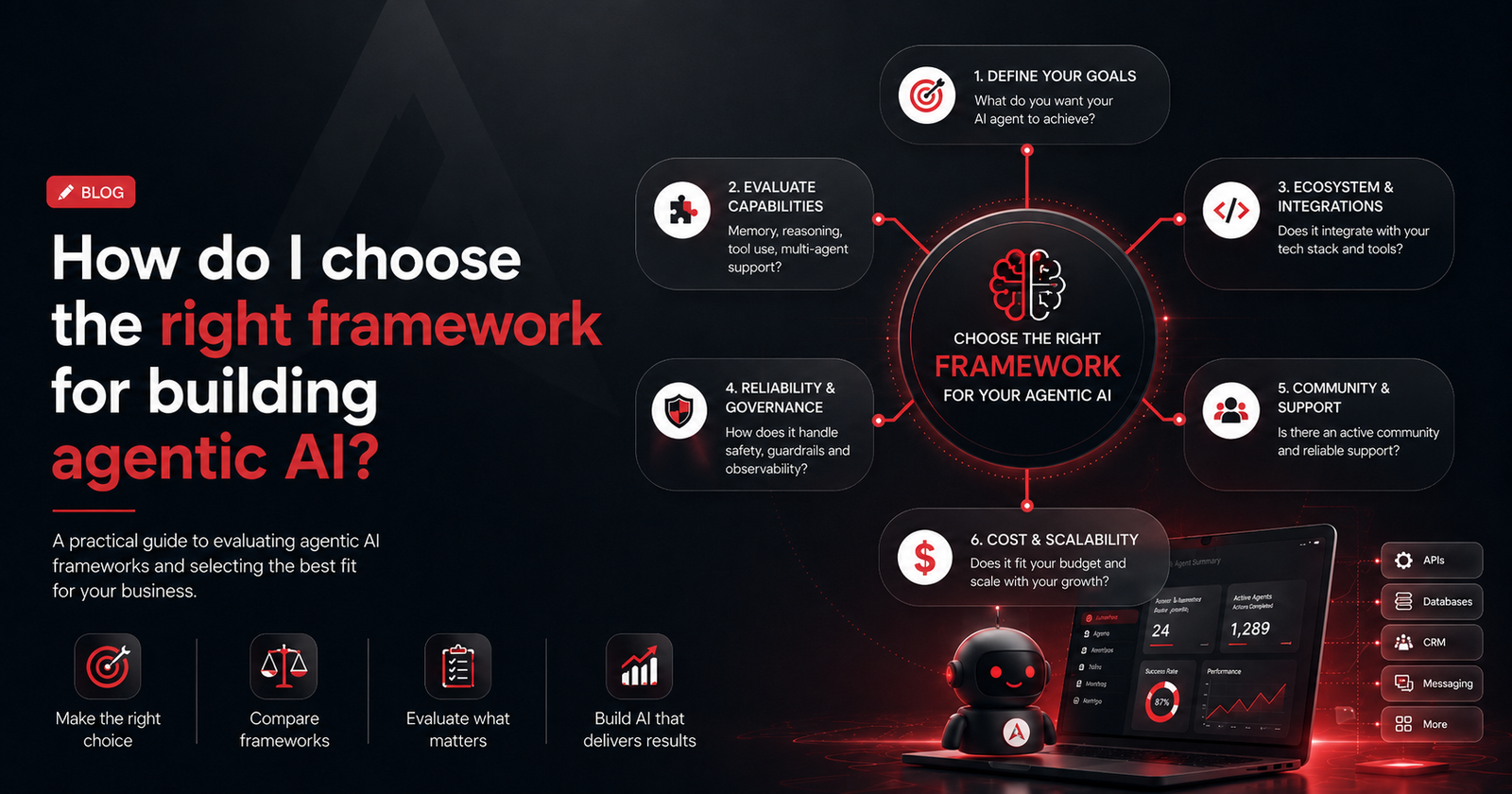
Choosing the best framework for agentic AI starts with the workflow you want to build, not the tool name. LangGraph, CrewAI, AutoGen, OpenAI Agents SDK and Semantic Kernel can all support agentic systems, but each one fits different levels of complexity, control, team skill and enterprise readiness.
This guide is part of Adcept’s agentic AI implementation cluster.
For background, read the pillar guide on what is agentic AI and the foundation article on agentic AI architecture.
Here, we will focus on how to choose the right framework for a real business build.
What Is an Agentic AI Framework?
An agentic AI framework is a development toolkit used to build AI agents that can plan, reason, use tools, call APIs, keep state and complete multi-step tasks.
A normal AI app may send a prompt to a language model and return a response.
An agentic AI framework adds structure around that model.
It can help manage:
- Tool calling
- Memory
- Agent roles
- Workflow state
- Human approval
- Multi-agent collaboration
- Error handling
- Tracing and monitoring
- API integrations
- Deployment patterns
OpenAI’s Agents SDK documentation describes orchestration features such as agents, runners, tools, guardrails, handoffs and sessions, which are common requirements in agentic applications.
Why Framework Selection Matters
Choosing the wrong framework can make an agentic AI project harder to scale, test, secure and maintain.
The best framework for agentic AI should match the business process, not just the developer’s preference.
A simple sales assistant does not need the same architecture as a multi-agent compliance workflow.
A healthcare admin agent does not need the same controls as an internal document research assistant.
The right choice depends on:
- Workflow complexity
- Data sensitivity
- Required integrations
- Team skills
- Hosting needs
- Human approval points
- Monitoring requirements
- Budget
- Long-term ownership
If your business is planning AI Development, framework selection should happen after the workflow has been mapped.
Best Framework for Agentic AI: Quick Answer
The best framework for agentic AI depends on the use case. LangGraph is strong for stateful workflows, CrewAI is useful for role-based multi-agent teams, OpenAI Agents SDK suits lightweight OpenAI-first builds, and Semantic Kernel fits Microsoft and enterprise environments.
AutoGen is still important, but Microsoft now says AutoGen is in maintenance mode and encourages new users to move toward Microsoft Agent Framework.
Best Framework for Agentic AI by Use Case
Choosing the right Agentic AI framework can significantly improve your AI application’s performance, scalability, and development speed.
Framework Comparison Table
Compare the top Agentic AI frameworks to choose the right solution for your next project.
LangGraph
LangGraph is often a strong choice when the workflow needs structure, state and human review.
It uses graph-based workflows, where each node can represent a task, decision, tool call or approval step.
LangGraph documentation highlights its use for stateful, long-running agents, with support for human-in-the-loop workflows where an agent can pause and resume after review.
When LangGraph Is the Best Framework for Agentic AI
LangGraph may be the best framework for agentic AI when the workflow needs:
- Branching logic
- Multiple steps
- State tracking
- Human approval
- Error recovery
- Long-running processes
- Clear workflow paths
Good use cases include:
- Lead qualification
- Document review
- Support escalation
- Claims processing
- Compliance checks
- Internal research agents
Pros
- Strong workflow control
- Good for complex agent logic
- Supports human-in-the-loop design
- Useful for production-style workflows
- Works well for agents that need memory and state
Cons
- More technical than simple frameworks
- Requires good engineering discipline
- May be too complex for basic use cases
CrewAI
CrewAI is built around agents, crews and flows.
It is useful when the task feels like a team of specialists working together.
CrewAI documentation describes agents with roles, tools and goals, as well as crews for collaborative intelligence and flows for more controlled execution.
When CrewAI Works Best
CrewAI is a good fit when the workflow needs role-based collaboration.
For example:
It can work well for:
- Research workflows
- Content planning
- Market analysis
- Internal reporting
- Sales preparation
- Multi-step marketing workflows
For broader context, read AI agents explained and AI agents for business.
Pros
- Clear role-based structure
- Easy to explain to business teams
- Good for collaborative tasks
- Useful for prototypes and team-style workflows
- Supports agents, crews and flows
Cons
- Multi-agent workflows can become noisy
- Needs clear task boundaries
- Can be harder to control if roles are vague
AutoGen
AutoGen is a Microsoft-origin framework for multi-agent AI systems.
It became popular for agent-to-agent conversations, research workflows and collaborative problem-solving.
However, new projects need to consider Microsoft’s current direction.
Microsoft’s AutoGen GitHub page states that AutoGen is now in maintenance mode and encourages existing users to migrate using Microsoft’s AutoGen to Agent Framework migration guide.
When AutoGen Still Makes Sense
AutoGen may still make sense when:
- You already have an AutoGen project
- Your team is doing research
- You need to maintain existing workflows
- You are testing multi-agent conversation patterns
- You are evaluating migration to Microsoft Agent Framework
Pros
- Strong history in multi-agent research
- Useful for experimentation
- Good for agent collaboration patterns
- Still relevant for existing builds
Cons
- Not the best starting point for many new projects
- Maintenance mode limits future confidence
- Microsoft’s newer Agent Framework should be reviewed
OpenAI Agents SDK
OpenAI Agents SDK is a lightweight framework for building agentic applications with OpenAI models.
It is useful when your team wants a simpler developer experience and strong support for tools, handoffs, guardrails and sessions.
OpenAI’s documentation says the SDK can manage turns, tools, guardrails, handoffs and sessions through its Agent and Runner structure.
When OpenAI Agents SDK Is the Best Framework for Agentic AI
OpenAI Agents SDK may be the best framework for agentic AI when you are building:
- Internal copilots
- Tool-using chat agents
- Sales assistants
- Support assistants
- API-connected agents
- Fast prototypes
- Simple handoff workflows
It is often a strong choice for focused builds where OpenAI is the preferred model provider.
Pros
- Lightweight and simple
- Good tool calling support
- Built-in concepts for handoffs and guardrails
- Strong fit for OpenAI-first teams
- Good for fast prototypes
Cons
- May need extra infrastructure for complex enterprise systems
- Less suitable if you need a model-agnostic strategy
- Monitoring and governance still need careful design
Semantic Kernel
Semantic Kernel is Microsoft’s SDK for building AI agents and connecting models to business systems.
It is often a good fit for teams already using Microsoft, Azure, .NET or Python.
Microsoft’s Semantic Kernel documentation includes agent abstractions, and its plugin model allows developers to expose existing functions so AI agents can call business logic.
When Semantic Kernel Works Best
Semantic Kernel can be a strong choice for:
- Enterprise AI systems
- Microsoft-heavy environments
- Azure-based deployments
- .NET or Python teams
- Internal copilots
- Business applications
- Plugin-based AI workflows
Pros
- Strong Microsoft ecosystem fit
- Good plugin approach
- Useful for existing business code
- Supports enterprise-style development
- Can support model flexibility
Cons
- May feel heavy for small projects
- Requires stronger software engineering skills
- Teams should also review Microsoft Agent Framework for new builds
Enterprise Requirements Checklist
Enterprise agentic AI systems need more than a working demo.
They need controls, governance and ownership.
Before choosing the best framework for agentic AI, check whether the project needs:
- Role-based access control
- Audit logs
- Prompt and output tracing
- Tool call monitoring
- Human approval
- Error handling
- Data privacy controls
- Secure API management
- Model routing
- Cost tracking
- Version control
- Deployment pipelines
- Data residency review
- Compliance documentation
- Incident response process
For businesses seeking AI Consulting, this checklist often reveals whether a lightweight SDK is enough or whether a more controlled framework is needed.
Framework Selection Checklist
Use this checklist before choosing a framework.
-
What Workflow Are You Automating?
Start with the process.
Examples:
- Lead routing
- CRM updates
- Support triage
- Healthcare admin
- Marketing campaign support
- Reporting
- Invoice checks
- Internal research
For industry use cases, see how agentic AI is transforming healthcare and AI agents reducing admin burden for healthcare clinics.
-
How Much Control Do You Need?
Use LangGraph or Semantic Kernel when control, state and governance matter.
Use OpenAI Agents SDK or CrewAI when you need a faster, smaller build.
-
Is the Workflow Single-Agent or Multi-Agent?
A single-agent workflow is often easier to test.
Multi-agent systems can help when the work has clear specialist roles.
Do not use multiple agents just because it sounds advanced.
-
Which Tools Must the Agent Use?
List every system the agent needs to access.
Examples include:
- CRM
- Email
- Calendar
- Database
- Helpdesk
- Accounting system
- Practice management software
- Marketing platform
- Reporting dashboard
This connects directly with AI Automation Services, where the value often comes from linking tools, workflows and decision points.
-
Who Will Maintain the System?
Choose a framework your team can support.
A brilliant prototype is not useful if no one can maintain it after launch.
-
What Are the Risk Levels?
Higher-risk workflows need stronger approval and monitoring.
Examples include:
- Healthcare communication
- Financial actions
- Legal review
- HR decisions
- Customer complaints
- Sensitive data access
-
What Is the Long-Term Strategy?
Think beyond version one.
Ask:
- Will more agents be added later?
- Will the system need multiple models?
- Will it run inside enterprise infrastructure?
- Will audit logs be required?
- Will business users need visibility?
- Will the agent need to connect with CRM automation or reporting?
For marketing workflows, the same thinking applies to platform decisions. See best marketing automation platforms.
Real Business Example
A professional services business wants an AI agent to manage inbound leads.
The desired workflow is:
For this workflow:
- OpenAI Agents SDK may work for a fast prototype.
- LangGraph may be better if the process needs state, branching and approval.
- Semantic Kernel may be better if the business is Microsoft-heavy.
- CrewAI may help if different agent roles are needed, such as research, qualification and response drafting.
The right choice depends on complexity, risk and ownership.
Common Mistakes
Mistake 1: Choosing Based on Popularity
The most talked-about tool is not always the best option.
Choose based on workflow requirements.
Mistake 2: Building a Multi-Agent System Too Early
Multi-agent systems can become harder to test and monitor.
Start simple where possible.
Mistake 3: Ignoring Human Approval
AI agents that send messages, update records or trigger actions need review points.
This is especially true in healthcare, finance and customer support.
Mistake 4: Forgetting Monitoring
Agentic systems need logs, traces and tool call records.
Without monitoring, it is hard to know what happened.
Mistake 5: Treating AI as Separate From Operations
AI agents should fit into existing business systems.
They should not create another disconnected process.
Best Practices for Choosing the Best Framework for Agentic AI
The best framework for agentic AI is the one that supports your workflow with the least unnecessary complexity.
Follow these best practices:
- Map the workflow first Document the process before choosing a framework.
- Start with a small pilot Pick one measurable use case.
- Choose simple before complex Do not over-engineer the first version.
- Add human approval early Use review steps for sensitive actions.
- Limit tool access Give the agent only the permissions it needs.
- Monitor every important action Track prompts, outputs, tool calls and errors.
- Design for handover Make sure the system can be maintained by the right team.
- Review after launch Improve prompts, workflows and data sources over time.
Expert Tip
Do not ask, “Which framework is best?”
Ask, “Which framework gives us the safest and simplest path to automate this workflow?”
That question usually leads to a better decision.
Future Trends
Agentic AI frameworks are moving towards safer, more observable and more enterprise-ready systems.
Future trends include:
- Better multi-agent orchestration
- Stronger guardrails
- More visual workflow design
- Model-agnostic agents
- Built-in tracing and observability
- More human-in-the-loop controls
- Deeper CRM and ERP integrations
- Safer tool calling
- Better cost tracking
- Industry-specific frameworks and templates
As these tools mature, businesses will focus less on the framework name and more on governance, workflow design and measurable outcomes.
Quick Summary
- The best framework for agentic AI depends on the business workflow.
- Choose LangGraph for stateful, controlled workflows.
- Choose CrewAI for role-based agent teams.
- Choose OpenAI Agents SDK for lightweight OpenAI-first agent apps.
- Choose Semantic Kernel for Microsoft and enterprise environments.
- Treat AutoGen carefully for new projects because Microsoft now points users toward Agent Framework.
Conclusion
The best framework for agentic AI is not a universal choice.
It depends on the workflow, integrations, risk level, team capability and enterprise requirements.
LangGraph is strong when you need state, branching and control.
CrewAI works well when the task fits role-based collaboration.
OpenAI Agents SDK is useful for lightweight, OpenAI-first builds.
Semantic Kernel is a strong option for Microsoft and enterprise environments.
AutoGen is still relevant for existing projects, but new builds should review Microsoft’s current Agent Framework direction.
For businesses, the smartest path is to start with the process, define the outcome and then choose the framework.
If you need help turning a use case into a working system, Adcept’s AI Automation Services can support workflow mapping, tool selection, integration and implementation.
Key Takeaways
- The best framework depends on workflow complexity, not popularity.
- LangGraph is strong for stateful, graph-based workflows.
- CrewAI suits role-based multi-agent collaboration.
- OpenAI Agents SDK is useful for lightweight OpenAI-first builds.
- Semantic Kernel fits Microsoft and enterprise environments.
- AutoGen is now better suited to existing projects than many new builds.
- Enterprise projects need monitoring, access control, audit logs and human approval.
- Start with one workflow before building a larger agentic system.
FAQs
What is the best framework for agentic AI?
The best framework for agentic AI depends on the use case. LangGraph suits stateful workflows, CrewAI suits multi-agent teams, OpenAI Agents SDK suits lightweight OpenAI-first apps, and Semantic Kernel suits Microsoft enterprise systems.
How do I choose an agentic AI framework?
Start by mapping the workflow, tools, data, risks and approval points. Then choose the simplest framework that can support those requirements safely.
Is LangGraph better than CrewAI?
LangGraph is better for controlled workflows with state, branching and human approval. CrewAI is better for role-based agent teams. The better choice depends on the task.
Is OpenAI Agents SDK good for production?
It can be used for practical agent apps, especially OpenAI-first builds. For complex enterprise workflows, you may need extra infrastructure for monitoring, governance and deployment.
Should new projects use AutoGen?
AutoGen may still suit existing projects and research workflows. For new Microsoft-related projects, review Microsoft Agent Framework because AutoGen is now in maintenance mode.
What is Semantic Kernel best for?
Semantic Kernel is best for teams using Microsoft, Azure, .NET, Python or enterprise application patterns. It is useful when AI agents need to connect with existing business code.
Do businesses always need an agent framework?
No. Some simple workflows can be built with direct APIs, Make, n8n or Zapier. A framework becomes more useful when the system needs memory, tool use, state, orchestration or multiple agents.
What should enterprises consider before choosing a framework?
Enterprises should consider security, audit logs, role-based access, monitoring, compliance, data residency, integration complexity, human approval and long-term maintenance.