Skip to content


Learn what Brand Radar is, how Ahrefs tracks AI visibility, and how brands can use AI citation tracking to grow reach.
The best marketing automation platforms help businesses manage leads, email campaigns, SMS, customer journeys, CRM updates and reporting without relying on manual follow-up. The right platform depends on your business model, customer data, sales process, budget and local compliance needs.
For some businesses, HubSpot is the best all-rounder. For e-commerce, Klaviyo or Omnisend may be stronger. For B2B enterprise teams, Salesforce can be a better fit.
This article is part of Adcept’s automation and agentic AI content cluster. For the bigger picture, read what is agentic AI and our guide to agentic AI architecture.
What Is a Marketing Automation Platform?
A marketing automation platform is software that helps businesses automate customer communication, lead nurturing, segmentation, campaign workflows and reporting.
It can send emails, trigger SMS messages, update CRM fields, score leads, segment contacts and move customers through personalised journeys.
Most platforms include:
- Email marketing
- SMS or WhatsApp messaging
- Landing pages or forms
- CRM integration
- Customer segmentation
- Journey builders
- Lead scoring
- Reporting dashboards
- Ecommerce triggers
- AI content and automation tools
Mailchimp describes marketing automation flows as automated workflows that can add tags, send targeted emails and complete important tasks for contacts.
Why Marketing Automation Platforms Matter
Marketing automation platforms matter because most businesses lose time and revenue through slow follow-up, messy contact data and inconsistent communication.
A good platform helps teams send the right message to the right person at the right time.
It also connects marketing with sales.
That matters for businesses where leads come from ads, website forms, referrals, events, ecommerce orders or inbound enquiries.
For businesses already exploring AI Automation Services, marketing automation is often one of the best starting points because it has clear workflows, measurable outcomes and direct customer impact.
Best Marketing Automation Platforms: Quick Comparison
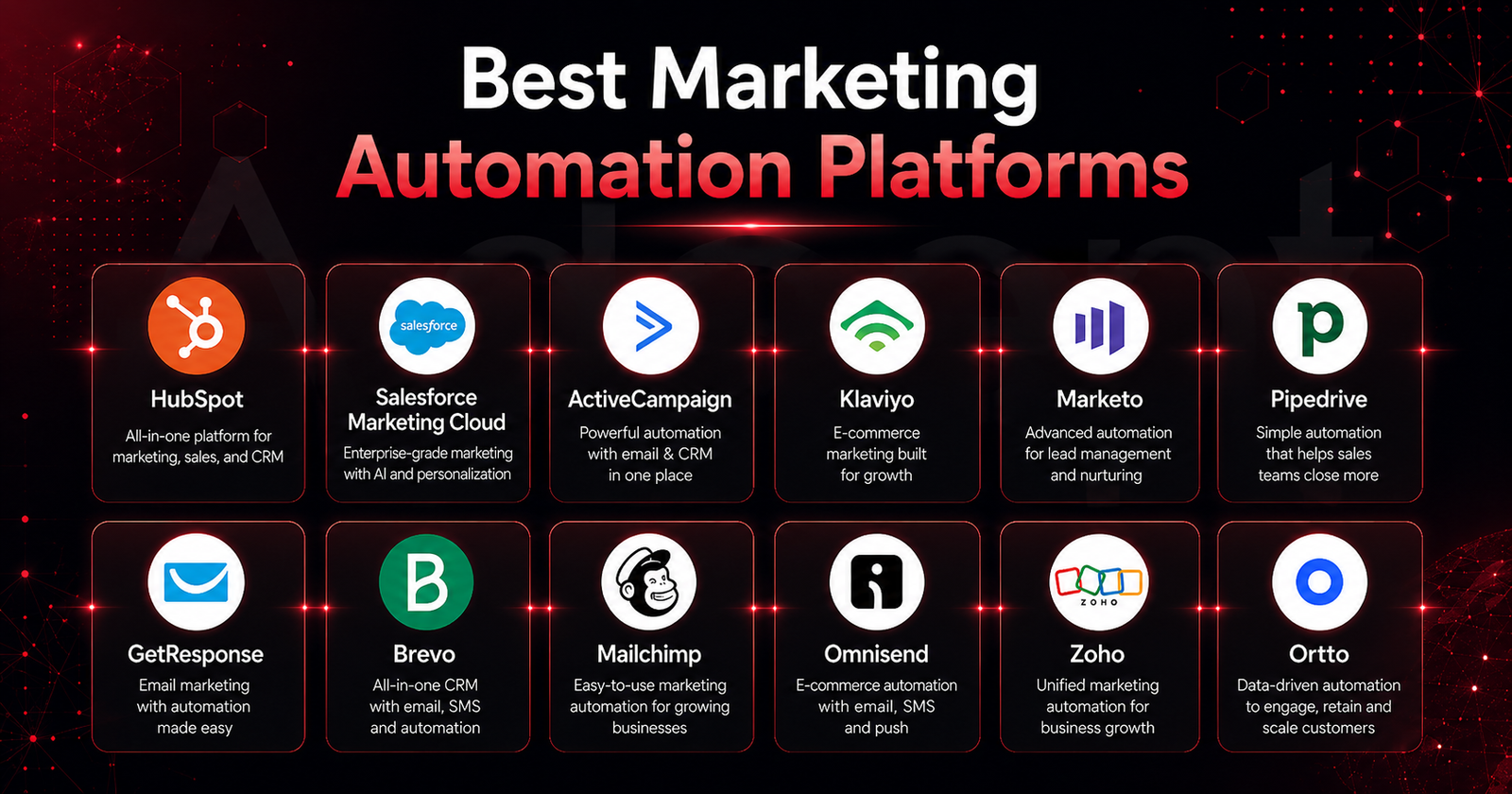
The best marketing automation platforms include HubSpot, ActiveCampaign, Klaviyo, Salesforce, Brevo, Mailchimp, Omnisend, Zoho and Ortto. HubSpot suits all-in-one CRM marketing, Klaviyo suits ecommerce, Salesforce suits larger B2B teams, and Brevo or Mailchimp can suit smaller businesses.
Platform Reviews
1. HubSpot
HubSpot is often one of the best marketing automation platforms for businesses that want CRM, email, forms, landing pages, lead scoring, automation and sales activity in one place.
HubSpot’s marketing automation software uses CRM data for workflows, email automation, lead scoring and journey orchestration.
HubSpot works well for:
- B2B services
- Consultants
- Agencies
- Education providers
- Healthcare admin teams
- Professional services
- Sales-led businesses
It is a strong choice when marketing and sales need one shared view of the customer.
The main caution is cost.
HubSpot can start simple, but advanced automation, reporting and seat requirements can increase the total spend.
2. ActiveCampaign
ActiveCampaign is known for strong email automation, segmentation, CRM features and multi-channel journeys.
Its platform includes marketing automation, CRM, content creation, analytics, email, SMS, WhatsApp and landing pages.
ActiveCampaign suits:
- Businesses with complex nurture sequences
- Coaches and course providers
- B2B lead nurturing
- Service businesses
- Ecommerce teams need advanced email logic
It is powerful, but it needs careful setup.
A messy automation map can become hard to maintain.
3. Klaviyo
Klaviyo is one of the strongest options for ecommerce and B2C brands.
Klaviyo describes itself as a B2C CRM and AI marketing platform that unifies customer data and automates email, SMS, RCS, WhatsApp and mobile push.
Klaviyo is best for:
- Shopify stores
- Fashion brands
- Beauty brands
- Supplements and wellness
- Retail ecommerce
- Repeat purchase businesses
Common flows include:
- Welcome series
- Abandoned cart
- Browse abandonment
- Post-purchase follow-up
- Win-back campaigns
- VIP customer offers
If your business is ecommerce-first, Klaviyo should be on the shortlist.
4. Salesforce Marketing Cloud and Account Engagement
Salesforce is usually best for larger sales-led businesses with mature CRM needs.
Salesforce Marketing Cloud Account Engagement is a B2B marketing automation platform built for marketing and sales alignment.
Salesforce suits:
- Enterprise B2B
- SaaS companies
- Franchise networks
- Larger sales teams
- Businesses already using Salesforce CRM
- Complex lead scoring and attribution
The main challenge is implementation.
Salesforce can be very strong, but it needs clean data, governance, trained users and proper integration design.
5. Brevo
Brevo is a practical all-in-one option for small and mid-sized businesses.
It includes email marketing, SMS, WhatsApp campaigns, push notifications, live chat, chatbot, CRM, transactional messaging and meetings.
Brevo suits:
- Small businesses
- Local service businesses
- Budget-conscious teams
- Businesses needing email and SMS
- Teams that also send transactional emails
It can be a good fit when you want more than basic email marketing but do not need a heavy enterprise platform.
6. Mailchimp
Mailchimp is still popular for small businesses, newsletters and simple customer journeys.
Its Customer Journey tools allow businesses to visually map automated marketing paths for customers across stages such as discovery, acquisition and retention.
Mailchimp suits:
- Startups
- Creators
- Small retailers
- Newsletter-led brands
- Simple nurture campaigns
- Businesses starting with email
It is easy to use, but it may not be the best long-term fit for businesses that need deep CRM automation, advanced lead scoring or complex sales handoffs.
7. Omnisend
Omnisend is built mainly for e-commerce email and SMS marketing.
Its Shopify listing describes email marketing, SMS, newsletters, web push, popups, signup forms, abandoned cart automation, welcome automation and product recommendations.
Omnisend suits:
- Shopify stores
- WooCommerce stores
- Online retailers
- Product-led brands
- Businesses wanting ecommerce automation without a heavy platform
It is a strong alternative to Klaviyo for ecommerce teams comparing cost, usability and features.
8. Zoho Marketing Automation
Zoho Marketing Automation is useful for businesses already using Zoho CRM, Zoho Campaigns, Zoho Books or Zoho Desk.
Zoho says its marketing automation features can analyse web behaviour, generate and nurture leads, qualify leads and automate multichannel marketing across email, SMS, WhatsApp and social media.
Zoho suits:
- SMEs
- Zoho CRM users
- Cost-conscious teams
- Businesses wanting sales and marketing tools in one ecosystem
It can offer strong value, but it works best when the wider Zoho setup is clean and well-managed.
9. Ortto
Ortto is useful for businesses that want marketing automation with customer data and analytics.
Ortto positions itself as a customer data, marketing automation and analytics platform that unifies data, messaging and analytics in one place.
Ortto suits:
- SaaS companies
- Growth teams
- Data-led marketers
- Businesses with product usage data
- Teams wanting automation and analytics together
It is less of a simple newsletter tool and more of a customer lifecycle platform.
How to Choose the Right Automation Platform
Choosing from the best marketing automation platforms starts with your business model.
Do not choose based only on brand popularity.
Use this checklist.
1. What Type of Business Are You?
- Ecommerce: Klaviyo or Omnisend
- B2B services: HubSpot or ActiveCampaign
- Enterprise B2B: Salesforce
- Small business: Mailchimp or Brevo
- Zoho-based business: Zoho Marketing Automation
- SaaS or product-led growth: Ortto
2. What Data Do You Need?
Think about whether your campaigns need:
- CRM data
- Website behaviour
- Purchase history
- Lead source
- Email engagement
- Deal stage
- Customer lifetime value
- Product usage
- Appointment history
Good automation depends on clean customer data.
3. What Channels Matter?
Most businesses start with email.
Some also need:
- SMS
- WhatsApp
- Web push
- Live chat
- Social ads
- Retargeting
- Sales tasks
- CRM notifications
Choose a platform that supports the channels your customers actually use.
4. Who Will Manage It?
A platform is only useful if someone can run it.
Consider whether management will sit with:
- Founder
- Marketing manager
- Sales team
- Agency
- Internal admin team
- Automation specialist
- External implementation partner
If the team has limited technical skills, choose a simpler platform or get setup support.
Local Australian Implementation Considerations
Australian businesses need to think beyond features.
Marketing automation must also respect local privacy, consent and unsubscribe rules.
Spam Act Compliance
The ACMA says commercial messages must contain a clear unsubscribe option and unsubscribe requests must be honoured within 5 working days.
That applies to email, SMS and other commercial electronic messages.
Before launching automated campaigns, check:
- Consent source
- Sender identification
- Unsubscribe links
- Suppression lists
- SMS opt-outs
- Data import history
- Lead capture wording
Privacy and Customer Data
The OAIC’s Australian Privacy Principles require open and transparent handling of personal information, including a clear and up-to-date privacy policy.
For marketing automation, this affects:
- Contact collection
- Segmentation
- Tracking
- Data sharing
- CRM notes
- AI enrichment
- Integrations
- Data retention
If using AI inside campaigns, review how customer data is processed.
This is especially important for healthcare, finance, education and other sensitive sectors.
Integration With Australian Business Systems
Local implementation often involves connecting platforms with:
- Xero
- MYOB
- Shopify
- WooCommerce
- Cliniko
- Halaxy
- HubSpot CRM
- Salesforce
- Google Workspace
- Microsoft 365
- Power BI
- Local SMS providers
This is where CRM Automation becomes important.
The best platform is not just the one with good email templates.
It is the one that connects cleanly with your sales, service and reporting process.
Business Use Cases
Lead Nurturing
A B2B service business can use HubSpot or ActiveCampaign to send helpful follow-up emails after a website enquiry.
The automation can update the CRM, assign a salesperson and create a follow-up task.
Ecommerce Lifecycle Marketing
An online fashion store can use Klaviyo or Omnisend to run welcome, abandoned cart, post-purchase and win-back flows.
These campaigns can use purchase behaviour and product interest.
Appointment-Based Services
A clinic, consultant or local service business can use Brevo, HubSpot or ActiveCampaign to manage reminders, intake follow-ups and reactivation campaigns.
For healthcare-related workflows, see our article on AI agents reducing admin burden for healthcare clinics and the broader guide to how agentic AI is transforming healthcare.
AI-Assisted Sales Follow-Up
AI agents can help classify leads, summarise enquiries and draft responses.
For context, see AI agents explained and AI agents for business.
This is where marketing automation starts to overlap with intelligent AI workflows.
Benefits and Challenges
Benefits of Marketing Automation Platforms
The best marketing automation platforms can improve speed, consistency and visibility across the customer journey.
Key benefits include:
- Faster lead follow-up
- Better customer segmentation
- More consistent communication
- Less manual campaign work
- Improved CRM data quality
- Clearer reporting
- Better sales and marketing alignment
- Stronger customer retention
Challenges of Marketing Automation Platforms
The main risks come from poor setup, messy data and unclear ownership.
Common challenges include:
- Duplicate contacts
- Weak consent records
- Poor naming conventions
- Over-emailing customers
- Broken integrations
- Unclear campaign goals
- No sales handoff process
- Too many unused automations
The platform does not fix the strategy by itself.
Common Mistakes
Mistake 1: Buying Too Much Too Early
Many businesses pay for features they do not use.
Start with the workflows that matter most.
Mistake 2: Ignoring Data Quality
Automation depends on clean fields, tags, lists and lifecycle stages.
Poor data creates poor targeting.
Mistake 3: No Compliance Review
Automated email and SMS campaigns still need consent, identification and unsubscribe controls.
Do not treat compliance as an afterthought.
Mistake 4: Building Too Many Journeys
More workflows can create more confusion.
Start with welcome, follow-up, abandoned cart or reactivation flows before building advanced journeys.
Mistake 5: No Link Between Marketing and Sales
If leads are nurtured but never handed to sales properly, automation will not create enough value.
Best Practices for Choosing the Best Marketing Automation Platforms
The best marketing automation platforms should match your customer journey, data quality, team capacity, sales process and compliance requirements.
Use these best practices:
- Map the customer journey first. Identify how people become leads, customers, and repeat buyers.
- Clean your contact data. Fix duplicates, invalid fields and old lists before migration.
- Start with core workflows. Build welcome, nurture, follow-up, and reactivation flows first.
- Connect CRM and reporting. Make sure marketing activity supports sales and management visibility.
- Review consent and unsubscribe rules, especially for email and SMS in Australia.
- Use segmentation carefully. Segment based on behaviour, lifecycle stage, interest and purchase history.
- Measure real outcomes. Track leads, sales, bookings, revenue and retention, not only opens.
- Review automations regularly. Update old messages, broken links and outdated offers.
Expert Tip
Do not choose a platform only because it has AI features.
Choose the platform that fits your data, sales process and customer journey.
AI becomes useful when the workflow underneath is clear.
Future Trends
Marketing automation is moving closer to agentic AI.
Platforms are adding AI assistants, campaign generation, predictive sending, journey suggestions, customer insights and automated recommendations.
Future trends include:
- AI-generated campaign workflows
- Predictive customer segments
- AI-assisted CRM updates
- Better journey orchestration
- More privacy-safe personalisation
- Deeper ecommerce automation
- AI agents for lead follow-up
- Automated reporting summaries
- More human approval controls
For deeper technical context, see our guide on the best framework for agentic AI and the comparison of AI agents vs virtual assistants.
Quick Summary
The best marketing automation platforms depend on your business type.
Choose HubSpot for all-in-one CRM marketing, ActiveCampaign for advanced email automation, Klaviyo or Omnisend for ecommerce, Salesforce for enterprise B2B, Brevo for affordable multi-channel marketing, Mailchimp for simple email, Zoho for Zoho users and Ortto for data-led growth teams.
For setup, strategy and integration support, Marketing Automation Services can help connect the platform to your CRM, campaigns, reporting and AI workflows.
Conclusion
The best marketing automation platforms are not the same for every business.
HubSpot is strong for CRM-led growth.ActiveCampaign is strong for advanced email journeys.Klaviyo and Omnisend are strong for ecommerce.Salesforce suits larger B2B teams.Brevo and Mailchimp are practical for smaller teams.Zoho and Ortto can be excellent when they match the wider business stack.
The right choice depends on your data, customer journey, team capability, compliance requirements and integration needs.
If your business wants marketing automation that connects with CRM, reporting, and AI workflows, Adcept’s AI Automation Services can help design a practical setup rather than just adding another tool.
Key Takeaways
- The best platform depends on the business model, not popularity.
- HubSpot is strong for all-in-one CRM and sales alignment.
- Klaviyo and Omnisend are strong choices for e-commerce.
- Salesforce is better suited to larger B2B and enterprise teams.
- Brevo and Mailchimp work well for simpler email and multi-channel needs.
- Australian businesses must manage consent, unsubscribe and privacy obligations.
- Clean CRM data is essential for effective automation.
- AI features work best when the workflow and data are already well designed.
FAQs
What are the best marketing automation platforms?
The best marketing automation platforms include HubSpot, ActiveCampaign, Klaviyo, Salesforce, Brevo, Mailchimp, Omnisend, Zoho and Ortto. The right choice depends on your business type, budget and CRM needs.
Which marketing automation platform is best for small businesses?
Mailchimp, Brevo and ActiveCampaign are common options for small businesses. Mailchimp is simple, Brevo is affordable for multi-channel campaigns, and ActiveCampaign offers stronger automation.
Which platform is best for e-commerce marketing automation?
Klaviyo and Omnisend are usually strong choices for e-commerce. They support abandoned cart flows, post-purchase campaigns, product recommendations, customer segments and SMS marketing.
Is HubSpot better than ActiveCampaign?
HubSpot is often better for businesses that want CRM, sales and marketing in one platform. ActiveCampaign is often stronger for advanced email automation and nurture sequences.
Is Salesforce good for marketing automation?
Yes, Salesforce is strong for larger B2B teams, especially when sales and marketing need close alignment. It usually needs proper implementation and ongoing management.
Do Australian businesses need consent for marketing automation?
Yes. Australian businesses must follow spam and privacy rules. Commercial messages usually need proper consent, clear sender details and a working unsubscribe option.
Can AI improve marketing automation?
Yes. AI can help with segmentation, campaign drafting, lead scoring, reporting and follow-up suggestions. It works best when connected to clean data and clear workflows.
How do I choose the right marketing automation platform?
Start by mapping your customer journey, CRM needs, sales process, channels, budget and compliance requirements. Then choose the platform that fits those needs with the least unnecessary complexity.