Skip to content


Learn how to read Google Search Console’s generative AI performance report, track AI Overviews visibility and measure AI traffic in GA4.
Most agency content is worthless because it is written to fill a calendar, not to solve a search problem. If you have ever read five agency blogs that all say the same thing with different headings, you already understand why agency content is worthless.
It is not because content marketing is dead.
It is because generic content has no edge.
In 2026, content needs one of four things to compete: original experience, useful structure, strong topical context or a real point of view. Without at least one of those, it becomes another forgettable blog post in a search result that AI can summarise in seconds.
Google’s guidance is clear that its ranking systems are designed to reward helpful, reliable, people-first content, not content created mainly to gain search rankings.
That is where many agencies get it wrong.
What Makes Agency Content Worthless?
Agency content becomes worthless when it has no original insight, no useful examples, no search intent alignment and no reason for a reader to trust it over ten similar articles.
It often looks polished.
But polished does not mean useful.
Common signs include:
- Generic introductions
- Recycled advice
- No examples
- No screenshots
- No process detail
- No opinion
- No real data
- Weak internal links
- No connection to the service offer
- No clear next step for the reader
A blog saying “SEO is important for business growth” does not help anyone.
A blog showing how to diagnose a real SEO problem, what to check first, and what to do next is different.
That is the gap.
Why Agency Content Is Worthless in 2026
Agency content is becoming worthless for one simple reason: sameness.
Too many agencies are still publishing safe, surface-level articles designed to target keywords rather than earn attention. But Google, AI Overviews, AI Mode, and buyers have all become better at filtering weak answers.
Google says SEO best practices still apply to AI features such as AI Overviews and AI Mode because those experiences are rooted in its core Search ranking and quality systems. So the fundamentals still matter—but the bar is higher.
AI search has made average content even easier to ignore. If an article only explains what is already obvious, users can get the same information from an AI-generated summary without needing to click.
Recent research into AI Overviews also suggests that AI-generated summaries can be associated with fewer clicks and more search sessions ending without a click, particularly when users get enough information directly from the search result.
That makes weak content more than an SEO problem. It can affect traffic, leads, and brand trust.
For service businesses, ranking for a keyword is not enough. A potential client is also asking:
- Does this team understand my problem?
- Have they done this before?
- Can I trust their process?
- Is their advice specific enough to be useful?
- Do they sound like strategists or content fillers?
The best agency content answers those questions through experience, original insight, specificity and commercial relevance.
The goal is no longer to produce another article that technically answers a search query. It is to publish something that demonstrates why the company behind it is worth listening to—and ultimately, worth hiring.
The Adcept Content Differentiation Framework
At Adcept, we do not treat content as writing output.
We treat it as a strategic asset.
Our content differentiation SEO framework has five layers:
If a topic fails these layers, we either reshape it or do not write it.
1. Search Intent
First, we ask what the user actually wants.
Are they trying to:
- Learn a concept?
- Compare options?
- Solve a technical problem?
- Estimate pricing?
- Choose an agency?
- Find a local provider?
- Validate a decision?
A “what is” keyword needs a different page from a “how much does it cost” keyword.
A comparison keyword needs a different angle from a technical build-log.
2. Business Relevance
A topic must connect to the business.
Not every high-volume keyword is worth chasing.
For example, an SEO agency may be tempted to write “what is marketing”.
But that topic is too broad and too far from buying intent.
A better topic may be:
- “SEO pricing in Australia”
- “Technical SEO audit checklist”
- “SEO for law firms”
- “AI Overviews impact on SEO”
- “Local SEO guide for Melbourne businesses”
These topics attract people with clearer problems.
3. Original Angle
Every page needs a reason to exist.
The angle may come from:
- An opinion
- A checklist
- A framework
- A case example
- A pricing breakdown
- A workflow
- A comparison
- An industry lens
- A technical process
This is where most agency content fails.
It answers the topic but adds nothing new.
4. Proof or Process
Readers trust specifics.
That can include:
- Screenshots
- Anonymised client examples
- Real workflow steps
- Before-and-after observations
- Audit findings
- Internal templates
- Decision tables
- Pricing logic
- SERP tracking data
This is also harder for competitors to copy.
They can copy a definition.
They cannot copy your actual process without doing the work.
5. Conversion Path
Good content should help the reader move forward.
That does not mean every blog needs a hard sell.
It means the next step should be clear.
Examples include:
- Read the related service page
- Download a checklist
- Request an audit
- Compare pricing
- Review a case study
- Book a consultation
- Read a deeper technical guide
A page with no conversion path is often just traffic with no business value.
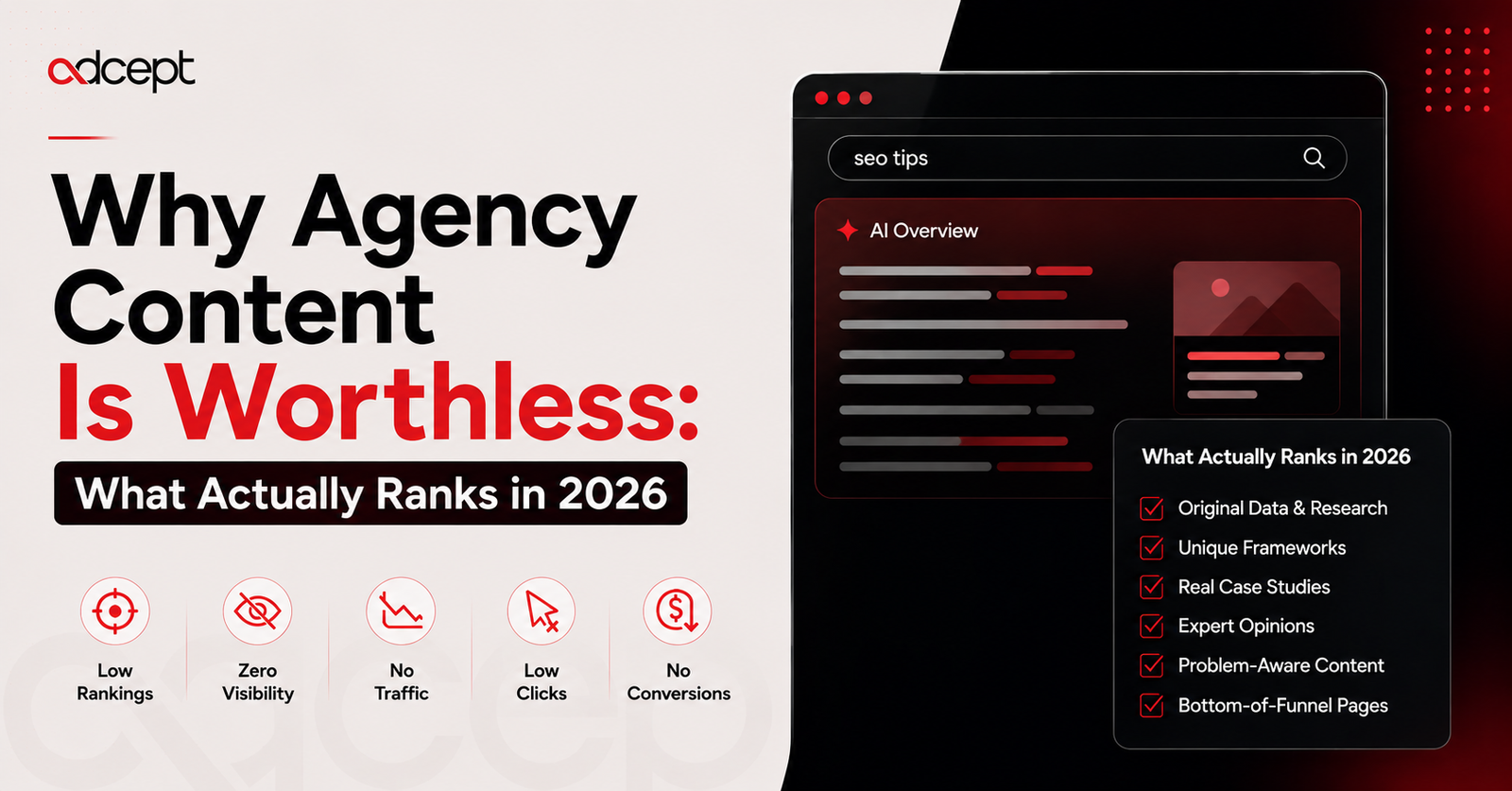
What Actually Ranks in 2026
Content that ranks in 2026 usually does more than answer a keyword. It satisfies intent, covers related entities, shows real experience, is technically accessible, and fits into a wider topical map.
Google’s spam policies also warn against scaled content abuse, where many pages are created mainly to manipulate rankings rather than help users.
That is important.
The issue is not whether content is written by a person or assisted by AI.
The issue is whether the page is useful.
Content Types That Make Your Brand Stand Out
This is why a strong content marketing strategy should not be a list of blog titles.
It should be a map of buyer problems, search intent, authority gaps and business outcomes.
Agency Content That Still Works
Agency content still works when it acts like consulting, not copywriting.
The strongest agency content usually has one of these angles.
1. Process Exposure
This shows how the agency actually works.
Examples:
- How we price SEO retainers
- How we run a technical SEO audit
- How we build an SEO content map
- How we classify AI Overview risk
Process content builds trust because it makes the invisible visible.
2. Contrarian Opinion
This challenges lazy industry thinking.
Examples:
- Why most SEO blogs should not exist
- Why AI content is not the real problem
- Why keyword volume is overrated
- Why cheap SEO usually costs more later
Opinion content works when it is backed by logic and examples.
It fails when it is only loud.
3. Real Implementation
This shows actual delivery.
Examples:
- An n8n SEO automation workflow
- A Google Search Console audit process
- A content refresh checklist
- A local SEO setup walkthrough
This content is harder to copy because it requires real capability.
4. Decision Support
This helps buyers choose.
Examples:
- SEO pricing in Australia
- SEO agency vs freelancer
- Local SEO vs national SEO
- Content marketing vs paid ads
Decision content often converts better than broad educational content.
Real Anonymised Client Examples
The following examples are anonymised, but they reflect patterns we see across SEO and content strategy work.
Example 1: The Blog Calendar That Produced Traffic but No Leads
A professional services client had more than 80 blog posts.
Most were generic articles like:
- “Benefits of outsourcing”
- “What is business consulting?”
- “How to improve productivity”
- “Why digital marketing matters”
The site had traffic, but few qualified enquiries.
The problem was not the writing quality.
The problem was weak commercial alignment.
We grouped the content into three buckets:
Then we shifted focus to service-led content, pricing explainers, industry pages and comparison articles.
The result was a clearer path from blog to enquiry.
Example 2: The Ecommerce Brand With Too Many Generic Guides
An ecommerce client had many informational blogs but weak category pages.
They ranked for low-intent questions but not for product-led terms.
Their content was answering curiosity, not buying behaviour.
We changed the strategy from generic blog growth to:
- Category page optimisation
- Product comparison guides
- Buying intent FAQs
- Internal links from blogs to categories
- Search Console query analysis
- Content refreshes around revenue pages
This is the difference between content volume and content value.
For ecommerce, content should support organic revenue, not just sessions.
Example 3: The Local Business With No Proof
A local service business had service pages that sounded like every competitor.
They said they were trusted, reliable and experienced.
But the pages did not show it.
We added:
- Suburb-specific context
- Common customer scenarios
- Real service process
- FAQs based on sales calls
- Review themes
- Before-and-after examples
- Strong internal links to local pages
This made the content more useful and more credible.
For local businesses, a page should not just say what the service is.
It should show why the business is a safe choice in that area.
How to Build a Better Content Marketing Strategy
A better content marketing strategy starts with what the business needs to be known for, then works backwards into keywords, pages and proof.
Do not start with “we need four blogs per month”.
Start with:
- What services need more demand?
- What questions block sales?
- What topics build trust?
- What pages should rank commercially?
- What examples can we show?
- What does the buyer need before enquiring?
- Which content can support internal links?
- Which pages need refreshing first?
Content Differentiation SEO Checklist
Use this checklist before approving a topic:
- Does the keyword have business value?
- Is the intent clear?
- Can we add a unique point of view?
- Can we include process, data or examples?
- Does it connect to a service page?
- Does it support a topical cluster?
- Can it earn internal links?
- Would a buyer trust us more after reading it?
- Is it better than an AI summary?
- Is it worth maintaining?
If the answer is mostly no, do not write it.
Simple Content Cluster Example
- This is how content starts building authority.
- Each article supports the others.
- Each internal link has a reason.
- Each page has a role.
Common Mistakes
Mistake 1: Publishing Without a Point of View
If the article says what everyone else says, it has no reason to win.
Add judgement.
Say what you would actually recommend.
Mistake 2: Treating AI as the Problem
AI is not the main reason content fails.
Weak strategy is.
AI just made it easier to publish more weak content faster.
Google’s 2024 spam policy update also clarified that scaled content abuse can involve automation or humans if the main purpose is manipulating rankings rather than helping users.
Mistake 3: Ignoring Internal Links
A blog with no internal links is isolated.
Good content should connect to service pages, pillar guides, and related articles.
For example, a content strategy article should naturally connect to SEO copywriting, semantic SEO and technical SEO.
Mistake 4: Writing for Volume Only
Four weak blogs per month are not better than one strong strategic asset.
A good content plan prioritises pages that can rank, convert or support authority.
Mistake 5: No Refresh Process
Content decays.
Search intent changes.
Competitors improve.
AI Overviews alter click behaviour.
A serious strategy includes content refreshes, not just new publishing.
Best Practices
Best Practices for Content Differentiation SEO
Content differentiation SEO means creating pages that are meaningfully different from competitor content through experience, structure, opinion, proof, examples, or useful tools.
Best practices include:
- Build around buyer problems
- Add original frameworks
- Use anonymised examples
- Include decision tables
- Show real process steps
- Link to relevant service pages
- Refresh old content regularly
- Write for clarity before length
- Use AI for research, not final judgement
- Track leads, not only traffic
Expert Tip
Before writing a blog, ask this:
“What can we say that a generic agency cannot?”
If the answer is nothing, the topic is not ready.
Find the angle first.
Write second.
Quick Summary
Most agency content is worthless because it is generic, safe, and disconnected from business outcomes.
What ranks in 2026 is content with clear intent, original insight, topical structure, proof, internal links, and a useful next step.
The agencies that win will not be the ones publishing the most.
They will be the ones publishing content that feels like strategy.
Conclusion
The reason why agency content is worthless is not that businesses do not need content.
They need better content.
They need pages that answer real questions, show real thinking and support real buying decisions.
In 2026, generic blogs are too easy to ignore.
AI can summarise them.
Competitors can copy them.
Readers can skim them and leave.
Strong content is different.
It has a point of view, a process, an example, a framework or proof that the business knows what it is doing.
That is where content becomes more than writing.
It becomes strategy.
Key Takeaways
- Most agency content fails because it is generic and commercially weak.
- AI has made average informational content easier to replace.
- Content should be judged by business relevance, not just keyword volume.
- Original frameworks, examples and process detail create differentiation.
- Strong content marketing strategy connects blogs, service pages and buyer intent.
- Content differentiation SEO helps pages stand out in crowded SERPs.
- Anonymised client examples and real workflows build trust.
- Fewer stronger assets usually beat high-volume generic publishing.
FAQs
1. Why is most agency content worthless?
Most agency content is worthless because it repeats common advice without original insight, examples, proof or business relevance. It may be well written, but it does not help the reader make a decision.
2. What kind of content ranks in 2026?
Content that ranks in 2026 is clear, useful, specific, and differentiated. It often includes original frameworks, real examples, technical detail, topical depth, strong internal links and a clear next step.
3. Is AI content bad for SEO?
AI content is not automatically bad. The problem is low-quality content created mainly to manipulate rankings. Human review, expertise, originality and usefulness still matter.
4. What is content differentiation SEO?
Content differentiation SEO is the practice of making content meaningfully different from competitors through original experience, examples, frameworks, data, screenshots, opinions, or implementation detail.
5. How do agencies create better content?
Agencies create better content by starting with search intent, business relevance, and a unique angle. The writing should come after the strategy, not before it.
6. Should businesses still invest in content marketing?
Yes, but not in generic content calendars. Businesses should invest in strategic content that supports service pages, answers buyer questions and builds topical authority.
7. How often should content be refreshed?
Important pages should be reviewed every few months, especially service pages, pricing guides, comparison articles and pages affected by AI Overviews or changing search intent.
8. What is the biggest content mistake agencies make?
The biggest mistake is publishing content because a keyword exists. A keyword is not a strategy. The content still needs a clear purpose, original angle, and business reason to exist.