
- Case Study
- /
- AI Work
- /
- Finance Differently Meeting Follow-Up Automation
Finance Differently Meeting Follow-Up Automation
Case
Study
Challenge
Every discovery meeting created two separate administrative tasks.
The broker had to:
- Write a client email summarising the discussion
- Restate the client’s goals
- Explain the agreed next steps
- Prepare an internal handover for the credit analyst
- Capture the loan purpose, likely lender direction and any special conditions
Both messages had to be written manually after every meeting.
This work was repetitive, but it could not be treated as generic administration. The client email needed to feel personal and reassuring, while the internal handover needed to be concise, structured and operationally useful.
The process also depended heavily on memory and the quality of notes taken during or immediately after the call. When meetings were close together, there was a risk that follow-ups could be delayed, important details could be missed or internal information could be presented inconsistently.
Duplicated Work Between Team Members
The internal handover created another challenge.
The credit analyst independently calculates servicing and borrowing capacity through specialist tools. Repeating those figures in the broker’s handover did not add value and could create duplicated work.
The handover therefore needed to exclude information the analyst would calculate independently and focus only on the details that influenced how the file should be handled.
An Existing Automation That Did Not Work
Finance Differently already had a partially built automation scenario, but it had never been successfully completed or tested from beginning to end.
The initial review found:
- No successful execution history
- A placeholder AI prompt
- An unconfigured email-send step
- A workflow that was only partially assembled
The assessment concluded that the scenario was approximately 30% built structurally but 0% functional.
The challenge was therefore not simply to add another step. It was to understand the business process, audit the unfinished work and rebuild the workflow around the actual needs of the two audiences.
Our Solution
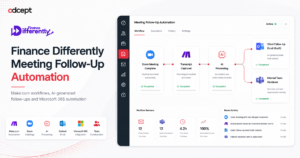
Adcept Marketing designed a meeting follow-up automation centred on the completion of a Zoom recording.
Once the relevant meeting recording becomes available, the workflow:
- Retrieves the meeting recording and transcript
- Confirms that the meeting is the correct type
- Sends the transcript through two separate AI instructions
- Creates a client follow-up email as a draft in Outlook
- Sends the internal handover directly to the credit analyst
The core strategy was based on audience-specific communication.
Rather than asking one AI prompt to produce a general meeting summary, the solution uses two distinct prompts with different goals, exclusions, tones and output structures.
This made the automation more useful than a basic transcript summariser.
About the Project
Turning Client Meetings Into Clear Follow-Ups and Faster Internal Handoffs
Client: Finance Differently
Industry: Mortgage broking and financial services
Services Provided: AI Workflow Automation, Meeting Follow-Up Automation, Email Drafting Automation, Internal Handover Automation, Make.com Integration and Microsoft 365 Automation
Finance Differently needed a more reliable way to manage the administrative work that followed every client discovery meeting. Adcept Marketing built an AI-assisted workflow that turns Zoom meeting transcripts into two purpose-built outputs: a client follow-up email for review and a structured internal handover that is sent automatically.
Client Overview
Finance Differently helps clients reduce the time required to repay their mortgage and lower the total interest they pay through a structured advisory approach.
The client journey begins with lead generation through Meta advertising, followed by booking and lead management in GoHighLevel. Prospective clients then attend a detailed discovery meeting over Zoom.
After that meeting, the client-facing broker manages the relationship and next steps, while a credit analyst takes over the loan-processing work when the client decides to proceed.
This made the quality of the post-meeting follow-up and internal handover an important part of the client experience.
Implementation
Discovery and Workflow Audit
The project began with a live walkthrough of the client’s existing automation.
This allowed Adcept Marketing to understand:
- How discovery meetings were conducted
- What happened immediately after each meeting
- What the client expected to receive
- What the credit analyst required
- Which parts of the unfinished workflow could be retained
- Which parts needed to be redesigned
A module-by-module assessment was then completed before development began.
The client received a written proposal covering the business process, workflow design, audit findings, scope, estimated hours and delivery approach.
This ensured the project was based on an agreed operational outcome rather than simply completing the partially configured scenario.
Zoom Recording Trigger
The workflow begins when Zoom confirms that a recording has been completed.
This trigger was chosen because it connects the automation directly to the end of the meeting process. The broker does not need to upload notes manually or start a separate workflow.
The automation requests the relevant Zoom access token, retrieves the recording files and locates the meeting transcript.
This creates a consistent source for the two follow-up outputs.
Meeting-Type Filtering
Not every recorded meeting should trigger the same follow-up process.
A meeting-type filter was added so the automation runs only for the relevant discovery meeting.
This prevents unrelated Zoom recordings from entering the workflow and reduces the risk of incorrect emails being created or sent.
The project was deliberately scoped around one meeting type for the initial phase. A second meeting process was left for a future stage rather than adding unnecessary complexity before the core workflow was proven.
Client Follow-Up Email Automation
The first AI prompt was designed specifically for the client.
It reviews the transcript and prepares an email that:
- Recaps the main discussion
- Reflects the client’s goals
- Uses clear, accessible language
- Explains the next steps
- Maintains a warm and professional tone
The output is created as a draft in the broker’s Outlook mailbox.
It is not sent automatically.
This allows the broker to check the email, make any personal adjustments and send it under her own name.
The workflow removes the burden of drafting the message from the beginning while preserving the broker’s ownership of the client relationship.
Internal Handover Automation
The second AI prompt was developed for the credit analyst.
Its purpose is not to repeat the full meeting or create another general summary. It produces a structured internal handover focused on the information required to progress the file.
The handover includes areas such as:
- Loan purpose
- Likely lender direction
- Non-standard conditions
- Open questions
- Important matters requiring further investigation
It deliberately excludes income figures, servicing calculations and borrowing-capacity estimates because the analyst derives those independently.
This reduces duplicated effort and keeps the handover focused on information that adds value.
Unlike the client email, the internal handover is sent automatically because it is operational, time-sensitive and does not require the same relationship-based review.
Two Purpose-Built AI Prompts
The two-prompt structure was one of the most important design decisions in the project.
A single prompt would have been asked to serve two very different readers:
- A client who needs reassurance, clarity and next steps
- An internal analyst who needs concise operational information
Combining these requirements would likely have produced an output that was too technical for the client or too broad for the analyst.
Each prompt was therefore given:
- A defined audience
- A clear purpose
- Specific information to include
- Specific information to exclude
- A structured output format
- An appropriate tone
This improved the relevance and consistency of both messages.
Human-in-the-Loop Review
The workflow uses automation differently depending on the risk and purpose of the communication.
The client email remains under human control. It is prepared as a draft, reviewed and then sent manually.
The internal handover is sent automatically because it follows a controlled structure and is intended for a known internal recipient.
This balance allows Finance Differently to reduce administrative effort without removing judgement from client-facing communication.
Microsoft 365 and Outlook Integration
The workflow connects directly with Microsoft 365 and Outlook.
The client email is created in the broker’s mailbox, where it fits naturally into her normal working process.
The internal email is generated and sent through the same environment, reducing the need to copy content between platforms or manage a separate communication tool.
This keeps the final step familiar for the team and makes the automation easier to adopt.
Controlled Project Scope
CRM changes and a second meeting type were intentionally excluded from the initial build.
This allowed the project to focus on the clearest and most repetitive administrative problem: producing two accurate post-meeting communications from one transcript.
The phased approach reduced complexity and created a foundation that can later be extended to additional meeting journeys.
Delivered Solution
An AI-powered post-meeting automation system connecting Zoom, Make.com, and Microsoft 365 to automatically process meeting recordings and transcripts, generate tailored follow-ups, and streamline internal handovers, while keeping humans in control of client communication.
Key Capabilities
- Automated Zoom recording & transcript processing
- Meeting-type detection with audience-specific AI prompts
- AI-generated client follow-up drafts
- Outlook draft creation for human review
- Automated internal handover emails with structured templates
- Information exclusion and communication safety rules
- Parallel workflow processing for faster execution
- Microsoft 365 integration and Make.com orchestration
- Phased automation architecture for controlled rollout
Business Impact
The automation removes two repetitive writing tasks from every relevant client meeting.
Instead of drafting both communications manually, the broker receives a prepared client email in Outlook and the credit analyst receives a consistent internal handover automatically.
This creates several practical improvements.
Reduced Manual Administration
The broker no longer needs to write both messages from a blank page after every discovery meeting.
The workflow converts the transcript into usable outputs while the meeting details are still current.
More Consistent Internal Handoffs
The analyst receives information in the same structure each time.
This reduces variation between handovers and makes it easier to identify the key details required to begin processing the file.
Less Duplicated Work
The handover deliberately excludes servicing and borrowing-capacity information that the analyst calculates independently.
This keeps each person focused on their own part of the process.
Faster Progression After Meetings
The internal handover can be delivered as soon as the workflow finishes, rather than waiting for the broker to complete both follow-up tasks manually.
Preserved Client Relationship
The client email is not sent without review.
The broker retains control of the final communication while spending less time preparing it.
Foundation for Future Expansion
The workflow was designed so it can later be extended to a second meeting type and another meeting platform as a separate project phase.
Technology Stack
Automation: Make.com · AI Workflow Automation · Business Process Automation
AI & Data: Claude API · Meeting Transcript Automation
Integrations: Zoom · Microsoft 365 · Outlook · GoHighLevel
Workflow: Email Automation · Human-in-the-Loop
Key Takeaways
- The main problem was repetitive post-meeting administration, not the meeting itself.
- Separate AI prompts produced more useful outputs for clients and internal staff.
- Excluding unnecessary financial calculations reduced duplicated work.
- Client-facing emails remained subject to human review.
- Internal handovers were automated to improve speed and consistency.
- A focused first phase created a practical base for future workflow expansion.
Conclusion
Adcept Marketing helped Finance Differently turn a repetitive post-meeting process into a structured and dependable automation workflow.
By connecting Zoom, Claude and Microsoft 365 through Make.com, the system creates two distinct outputs from the same meeting transcript: a client email ready for review and a concise internal handover ready for action.
The result is a more efficient process that reduces manual drafting, improves consistency between team members and allows the broker to maintain personal control over every client-facing message.
Next Read.
Your Success Story
Starts Here!
