Skip to content


Learn what Brand Radar is, how Ahrefs tracks AI visibility, and how brands can use AI citation tracking to grow reach.
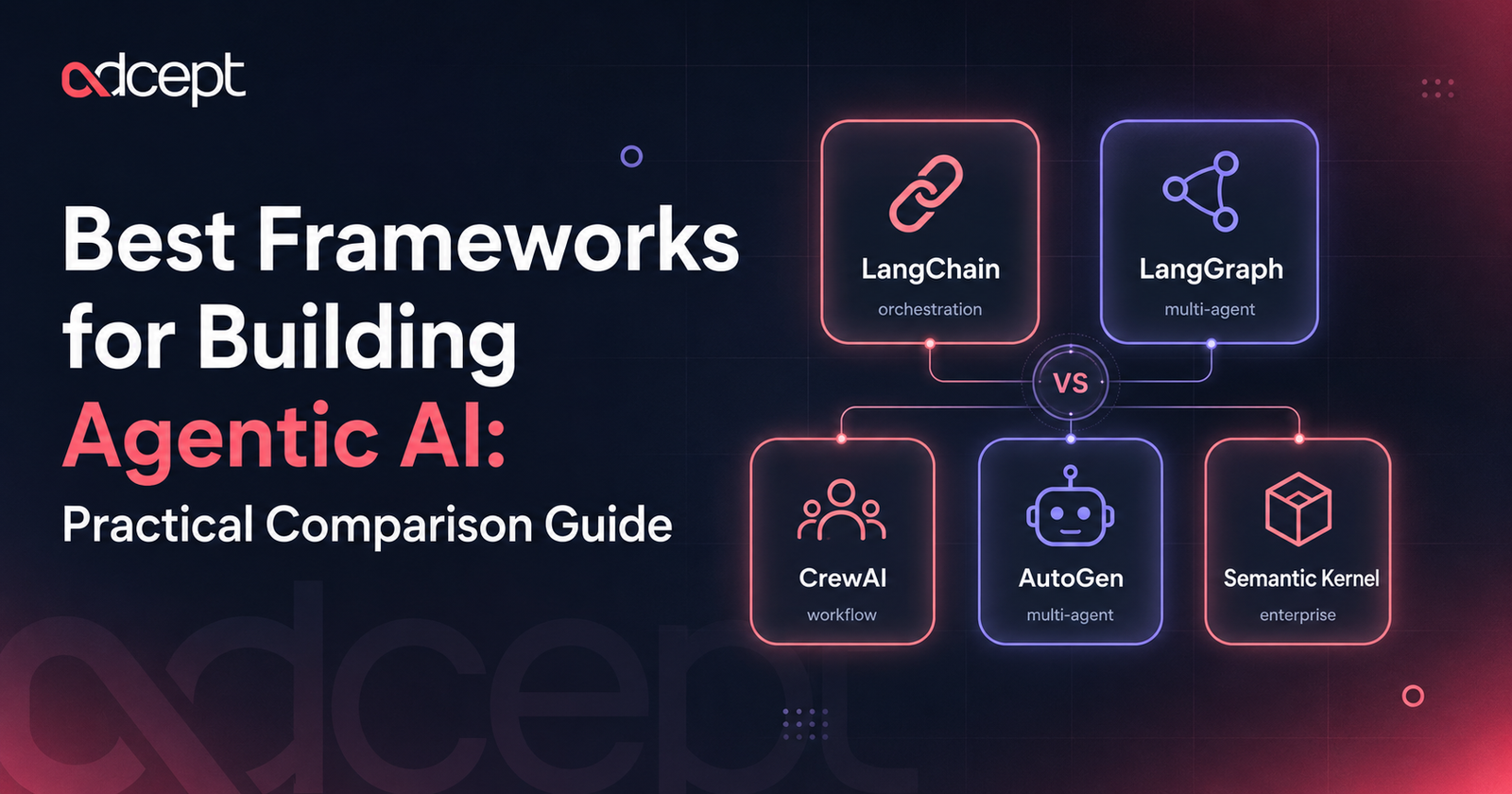
Choosing the best framework for agentic AI depends on what you are building, your development team, your existing systems and how much control you need. Some frameworks are better for graph-based workflows. Others suit multi-agent teams, Microsoft environments or lightweight OpenAI-based agents.
This guide compares LangGraph, CrewAI, AutoGen, OpenAI Agents SDK and Semantic Kernel from a practical business implementation view.
For the wider concept, read our pillar guide on what agentic AI is. For the system design layer, see our guide to agentic AI architecture.
What Is an Agentic AI Framework?
An agentic AI framework is a developer toolkit used to build AI agents that can plan, reason, use tools, call APIs and complete multi-step workflows.
A normal AI application may send a prompt to a language model and return a response.
An agentic framework adds structure around that model.
It can manage:
- Agent roles
- Tool calling
- Memory
- Workflow state
- Multi-agent collaboration
- Human approval
- Error handling
- Monitoring
- Deployment patterns
OpenAI describes agents as applications that can plan, call tools, collaborate across specialists and keep enough state to complete multi-step work.
Why Choosing the Right Framework Matters
Choosing the right framework matters because agentic AI systems often touch real business processes. The wrong choice can create technical debt, poor monitoring, weak control and unreliable automation.
The best framework for agentic AI is not always the most popular one.
It is the one that fits you:
- Business workflow
- Development skills
- Hosting environment
- Risk level
- Integration needs
- Monitoring requirements
- Preferred LLM provider
- Long-term maintenance plan
For example, a prototype may work well in a lightweight SDK.
A regulated workflow may need stronger state management, approval steps and observability.
Businesses planning AI Agent Development should choose the framework after mapping the workflow, not before.
Best Framework for Agentic AI: Quick Comparison
The best framework for agentic AI depends on the use case. LangGraph suits controlled stateful workflows, CrewAI suits role-based multi-agent teams, OpenAI Agents SDK suits lightweight OpenAI-first builds, and Semantic Kernel suits Microsoft and enterprise environments.
LangGraph
LangGraph is a low-level orchestration framework for long-running, stateful agents. It is often used when developers need clear workflow control, durable execution and human-in-the-loop checkpoints.
LangGraph is built around graph structures.
Each node can represent a step, agent, tool or decision point.
This makes it useful when the workflow is not a straight line.
When LangGraph Is the Best Framework for Agentic AI
LangGraph may be the best framework for agentic AI when your workflow needs state, branching, retries, approvals or complex orchestration.
It suits:
- Sales qualification workflows
- Support escalation systems
- Research agents
- Document review agents
- Internal operations agents
- Multi-step approval processes
Pros
- Strong control over workflow structure
- Good for stateful and long-running agents
- Supports human-in-the-loop design
- Useful for complex branching workflows
- Works well with LangChain ecosystem tools
Cons
- More technical than simple no-code tools
- Requires thoughtful workflow design
- May be more than needed for a basic chatbot
Simple LangGraph Example
CrewAI
CrewAI is designed for building collaborative AI agents, crews and flows. Its documentation describes support for agents, crews, guardrails, memory, knowledge and observability.
The main idea is simple.
You create agents with roles, goals and tools.
Then you organise them into a crew that works together.
When CrewAI Works Best
CrewAI is useful when the work naturally fits a team structure.
For example:
- Researcher agent
- Writer agent
- Reviewer agent
- Data analyst agent
- Customer support agent
- Sales assistant agent
This can make agent design easier for business teams to understand.
Pros
- Good for role-based multi-agent workflows
- Easy mental model for teams
- Useful for research, content and operations workflows
- Supports memory and knowledge features
- Can move from prototype to more structured workflows
Cons
- Multi-agent systems can become hard to control
- Requires clear task boundaries
- Output quality depends on role design and tool setup
Real Example
A marketing workflow may include:
This is useful for content planning, competitor review and campaign preparation.
For deeper agent concepts, see our related guide on AI agents explained.
AutoGen
AutoGen is a Microsoft-origin framework for building multi-agent AI applications. Microsoft’s documentation describes AutoGen as supporting deterministic and dynamic agentic workflows for business processes and research on multi-agent collaboration.
AutoGen became popular for agent-to-agent conversations.
It is useful for experimentation, research and collaborative task solving.
However, there is an important current note.
Microsoft’s AutoGen GitHub page states that AutoGen is now in maintenance mode and that new users should start with Microsoft Agent Framework.
When AutoGen May Still Be Useful
AutoGen can still be useful for teams with existing projects, research prototypes or internal experiments already built on it.
It suits:
- Multi-agent research
- Agent conversation testing
- Human-in-the-loop experiments
- Prototyping collaborative agents
Pros
- Flexible multi-agent conversations
- Strong research history
- Good for experimentation
- Supports human-in-the-loop patterns
Cons
- Maintenance mode means new feature development is limited
- New Microsoft projects may be better placed on the Agent Framework
- Production use needs careful review
Practical Note
If your team is starting fresh in the Microsoft ecosystem, compare AutoGen with Microsoft Agent Framework and Semantic Kernel before committing.
OpenAI Agents SDK
The OpenAI Agents SDK is a lightweight framework for building agentic AI apps. OpenAI describes it as having a small set of primitives and support for agents, handoffs, guardrails, sessions and tool use.
It is a strong choice when your team wants to build directly around OpenAI models and tools.
The SDK is designed to keep the developer experience simple.
When OpenAI Agents SDK Is the Best Framework for Agentic AI
OpenAI Agents SDK may be the best framework for agentic AI when you need a lightweight agent application, fast development and direct use of OpenAI’s Responses API.
It suits:
- Customer support assistants
- Internal copilots
- Tool-using chat agents
- Sales support agents
- API-connected assistants
- Early-stage prototypes
Pros
- Lightweight and simple to use
- Strong OpenAI model support
- Good tool calling support
- Supports handoffs and guardrails
- Useful for fast prototypes and focused agent apps
Cons
- May need extra infrastructure for complex enterprise workflows
- OpenAI-first design may not suit every model strategy
- Requires careful design for monitoring and deployment
Tool Calling Example
OpenAI’s documentation explains that tools let agents take actions such as fetching data, running code and calling external APIs.
A simple business agent may:
Semantic Kernel
Semantic Kernel is Microsoft’s model-agnostic SDK for building, orchestrating and deploying AI agents and multi-agent systems. It supports plugins, memory, planning and model flexibility across providers.
It is often attractive for teams already using Microsoft tools, Azure, .NET, Python or enterprise application patterns.
Semantic Kernel can connect LLMs with existing business code through plugins.
This makes it practical for companies that want AI agents to use current internal systems rather than rebuild everything.
When Semantic Kernel Works Best
Semantic Kernel is a strong choice for:
- Microsoft-heavy environments
- .NET and Python teams
- Enterprise AI workflows
- Internal copilots
- Business process automation
- Systems needing plugins and structured integration
Pros
- Model-agnostic
- Strong Microsoft ecosystem fit
- Good plugin approach
- Supports multiple programming languages
- Better suited to enterprise-style software teams
Cons
- May be more complex than needed for simple projects
- Microsoft’s newer Agent Framework should also be reviewed
- Requires software engineering discipline
Current Microsoft Direction
Microsoft says its newer Agent Framework combines AutoGen’s simple agent abstractions with Semantic Kernel’s enterprise features, including session-based state management, type safety, middleware, telemetry and graph-based workflows.
So, if your project is Microsoft-first, review Semantic Kernel and Microsoft Agent Framework together.
How to Choose the Best Framework
Choosing the best framework for agentic AI starts with the workflow, not the technology.
Use this checklist.
-
What Is the Business Goal?
Be specific.
Examples:
- Reduce manual lead follow-up
- Triage customer support tickets
- Automate weekly reporting
- Review documents faster
- Improve CRM data quality
-
How Complex Is the Workflow?
Ask whether the process needs:
- Branching
- Memory
- Human approval
- Multiple agents
- Long-running state
- Error recovery
- Tool calling
- Audit logs
Simple workflows need simpler tools.
Complex workflows need stronger orchestration.
-
What Systems Must It Connect To?
List the required integrations.
Examples include:
- CRM
- Email
- Calendar
- Helpdesk
- Database
- ERP
- Accounting system
- Reporting tool
- Internal API
For business implementation, AI Consulting can help identify whether an agent framework, workflow automation platform or hybrid approach is the right fit.
-
Who Will Maintain It?
A framework must match the team.
Choose based on whether maintenance will be handled by:
- Internal developers
- Automation specialists
- Data engineers
- IT team
- External AI partner
- Business operations team
-
What Level of Control Is Needed?
High-risk workflows need stronger controls.
Consider:
- Human approval
- Role-based access
- Logs and traces
- Error handling
- Security review
- Data governance
- Testing process
Business Use Cases
Agentic AI frameworks can support many practical business workflows.
Lead Qualification
The agent reads enquiries, checks CRM history, scores the lead and drafts a follow-up.
Best fit:
- LangGraph for structured branching
- OpenAI Agents SDK for lightweight tool use
- Semantic Kernel for Microsoft environments
Customer Support Triage
The agent classifies tickets, retrieves policy information and routes urgent issues.
Best fit:
- LangGraph for escalation workflows
- CrewAI for specialist support roles
- Semantic Kernel for enterprise systems
For service-based businesses, this connects well with broader use cases discussed in AI agents for business.
Healthcare Admin Support
Clinics can use agents to organise enquiries, prepare summaries and reduce repetitive admin tasks.
This must be designed with strong privacy and approval controls.
For more context, see AI agents reducing admin burden for healthcare clinics.
Virtual Assistant Replacement
Some businesses compare AI agents with virtual assistants.
The key difference is that AI agents can work through connected systems, while virtual assistants usually rely on manual human work.
See our guide on AI agents vs virtual assistants for a deeper comparison.
Common Mistakes
Mistake 1: Choosing the Framework First
Do not start with LangGraph, CrewAI or OpenAI Agents SDK just because they are popular.
Start with the workflow.
Then choose the framework.
Mistake 2: Building Too Many Agents
More agents do not always mean better results.
A simple single-agent workflow may be more reliable than a complex multi-agent setup.
Mistake 3: Ignoring Monitoring
Agent workflows need logs, traces, error handling and review points.
Without monitoring, debugging becomes difficult.
Mistake 4: Giving Agents Too Much Access
Limit tool permissions.
An agent should only access what it needs to complete the task.
Mistake 5: Skipping Human Approval
Sensitive actions should involve a person.
This includes financial decisions, legal responses, medical information, refunds and customer complaints.
Best Practices for Choosing the Best Framework for Agentic AI
The best framework for agentic AI should match the workflow complexity, team skills, risk level, integration needs and long-term support model.
Use these best practices:
- Start with a small pilot. Choose one clear workflow with measurable value.
- Map the process first. Document inputs, outputs, decisions and approval points.
- Pick the simplest suitable framework. Avoid unnecessary complexity.
- Use strong tool permissions. Restrict what the agent can access and change.
- Design human-in-the-loop steps. Add review points where judgement matters.
- Log every important action. Track prompts, outputs, tools, errors and approvals.
- Test edge cases: include missing data, unclear requests and failed APIs.
- Review after launch: Improve prompts, workflows and knowledge sources over time.
Expert Tip
If your business has no internal AI engineering team, avoid starting with the most complex framework.
A focused implementation using AI Automation may deliver faster value than a large custom agent platform.
Future Trends
Agentic AI frameworks are moving towards safer, more observable and more enterprise-ready systems.
Important trends include:
- Better multi-agent orchestration
- Stronger human approval patterns
- More visual workflow builders
- Improved observability
- Model-agnostic agent design
- Better memory controls
- More secure tool calling
- Deeper CRM and ERP integrations
- Industry-specific agent templates
The next stage will not be about one framework winning everything.
Most businesses will use a mix of LLM APIs, workflow automation platforms, agent SDKs and internal systems.
Quick Summary
The best framework for agentic AI depends on what you are building.
Choose LangGraph for stateful workflows, CrewAI for role-based agent teams, OpenAI Agents SDK for lightweight OpenAI-first agents, and Semantic Kernel for Microsoft or enterprise environments.
AutoGen is still useful to understand, but new Microsoft projects should review the Microsoft Agent Framework due to AutoGen’s maintenance status.
Conclusion
The best framework for agentic AI is the one that fits your workflow, risk level, integrations and team capability.
LangGraph is strong for structured, stateful workflows.
CrewAI is useful for role-based multi-agent collaboration.
OpenAI Agents SDK is a good fit for lightweight agent apps and tool use.
Semantic Kernel suits Microsoft-focused and enterprise-style builds.
AutoGen remains important historically and for existing projects, but new teams should review Microsoft’s current Agent Framework direction.
For business implementation, the smartest approach is to start with the process, define the outcome and then choose the framework.
That is how agentic AI moves from a prototype to useful automation.
Key Takeaways
- The best framework depends on workflow complexity, not popularity.
- LangGraph is strong for stateful, graph-based workflows.
- CrewAI is useful for role-based multi-agent teams.
- OpenAI Agents SDK is practical for lightweight OpenAI-first agents.
- Semantic Kernel suits Microsoft and enterprise environments.
- AutoGen is now in maintenance mode, so new Microsoft projects should review Agent Framework.
- Human approval, monitoring and access control are essential.
- Start small, prove value and scale the framework only when needed.
FAQs
What is the best framework for agentic AI?
The best framework for agentic AI depends on the use case. LangGraph is strong for stateful workflows, CrewAI for multi-agent teams, OpenAI Agents SDK for lightweight agent apps, and Semantic Kernel for Microsoft environments.
Is LangGraph better than CrewAI?
LangGraph is better for controlled graph-based workflows and state management. CrewAI is better when you want role-based agents working as a team. The right choice depends on the workflow.
Is AutoGen still worth using?
AutoGen is still useful for existing projects and research, but Microsoft now says new users should start with Microsoft Agent Framework. Review the current Microsoft direction before starting a new AutoGen project.
When should I use the OpenAI Agents SDK?
Use OpenAI Agents SDK when you want a lightweight way to build tool-using agents with OpenAI models, handoffs, sessions and guardrails. It is a good fit for focused agent apps.
What is Semantic Kernel best for?
Semantic Kernel is best for teams using Microsoft, Azure, .NET, Python or enterprise integration patterns. It is useful when agents need to connect with existing business code and systems.
Do I need a framework to build an AI agent?
Not always. A simple agent can be built with direct API calls and workflow automation tools. A framework becomes more useful when the agent needs memory, tools, state, orchestration or multiple roles.
Which framework is best for business automation?
For business automation, LangGraph and Semantic Kernel are strong choices for structured workflows. OpenAI Agents SDK suits lighter agent apps, while CrewAI is useful for collaborative agent teams.
How should a business choose an agentic AI framework?
Start by mapping the workflow, integrations, risks, approval points and maintenance needs. Then choose the simplest framework that can support those requirements safely.