Skip to content


Learn how to read Google Search Console’s generative AI performance report, track AI Overviews visibility and measure AI traffic in GA4.
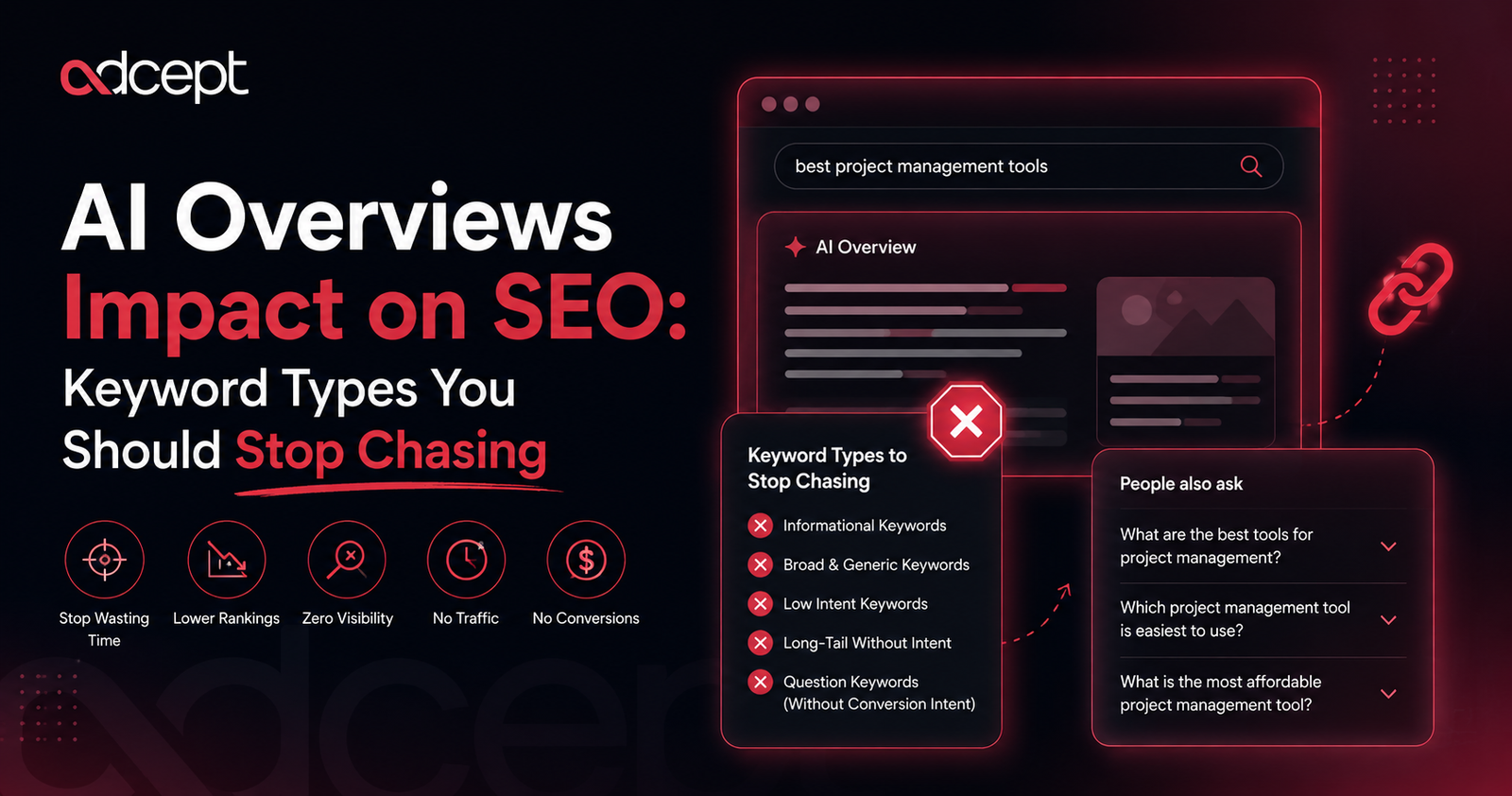
The AI Overviews impact on SEO is not evenly spread across every keyword. Some searches still send valuable traffic. Others are being answered directly in the results, leaving websites with impressions but fewer clicks.
That is the uncomfortable part.
Many SEO teams are still chasing keyword types that no longer deserve the same effort.
Google says AI Overviews appear when its systems decide generative AI can be helpful, especially when users want to quickly understand information from a range of sources.
So the real question is not “Will AI kill SEO?”
The better question is: which keywords are already losing their job?
What Is the AI Overviews Impact on SEO?
The AI Overviews impact on SEO is the shift in clicks, visibility, and search behaviour caused by AI-generated summaries appearing above or within Google results. These summaries can answer simple queries directly, which means some rankings may still look healthy while organic traffic falls.
Google’s own guidance says SEO best practices still apply to AI features, including AI Overviews and AI Mode. Sites still need to meet technical requirements, follow Search policies, and create helpful, reliable, people-first content.
That is true.
But it does not mean every old keyword strategy still makes sense.
A keyword can still rank and still be commercially weak.
A page can still get impressions and still lose the click.
Our Contrarian Take
AI Overviews did not kill SEO.
They killed lazy informational keyword targeting.
For years, SEO teams filled content calendars with basic queries like:
- “What is X?”
- “Benefits of X”
- “X vs Y”
- “How does X work?”
- “How long does X take?”
- “Pros and cons of X”
Some of these still matter.
But many are now answerable without a website visit.
Ahrefs reported that AI Overviews reduced clicks to the top-ranking page in its study, reinforcing that AI summaries can create real click loss for informational searches.
Semrush also found that AI Overviews first appeared heavily across long-tail informational searches before expanding into more commercial query types.
Our view is simple: stop treating every informational keyword as a traffic asset.
Some are now visibility assets.
Some are trust assets.
Some are not worth building a standalone page for anymore.
Keyword Types AI Overviews Are Killing
These are the keyword types most exposed to AI search.
This does not mean they should never appear on your site.
It means they should usually be handled inside stronger pages, not chased as standalone traffic plays.
1. Basic Definition Keywords
Basic definition keywords are the easiest for AI Overviews to answer.
Examples:
- “What is technical SEO?”
- “What is local SEO?”
- “What is email marketing?”
- “What is schema markup?”
- “What is search intent?”
AI can summarise these in a few lines.
Users often do not need to click unless they want depth, examples, or implementation.
What to Do Instead
Do not build thin definition-only articles.
Use definitions as short sections inside:
- Service pages
- Pillar guides
- Comparison pages
- Implementation guides
- Industry-specific articles
For example, a definition of local SEO belongs inside a full local SEO guide, not as a weak 600-word glossary post.
2. Generic “Benefits of” Keywords
AI Overviews can easily list benefits.
Examples:
- “Benefits of SEO”
- “Benefits of content marketing”
- “Benefits of automation”
- “Benefits of Google Business Profile”
- “Benefits of email marketing”
These queries are often too early in the customer journey.
They rarely show strong buying intent.
What to Do Instead
Turn benefit content into proof.
Use:
- Case studies
- Before-and-after examples
- Industry examples
- Cost of inaction sections
- Decision frameworks
A user does not need “SEO improves visibility.”
They need to know whether SEO is worth it for their business model, budget, and market.
3. Simple Comparison Keywords
AI search is very good at basic comparisons.
Examples:
- “SEO vs Google Ads”
- “n8n vs Zapier SEO”
- “Local SEO vs organic SEO”
- “On-page SEO vs technical SEO”
- “AI agents vs virtual assistants”
The simple table is no longer enough.
AI can generate that table instantly.
What to Do Instead
Make comparison pages opinionated.
Add:
- Who should choose each option
- Pricing considerations
- Implementation risks
- Local market examples
- Decision checklist
- Real tool screenshots
- “What we would choose” sections
A good comparison should help a buyer make a decision, not just define two terms.
4. Short “How To” Keywords With No Stakes
Some “how to” searches are now too easy.
Examples:
- “How to write a meta description”
- “How to add alt text”
- “How to check page speed”
- “How to submit sitemap”
- “How to write a title tag”
These are useful, but they are often low-value as standalone pages.
AI Overviews, featured snippets, and tool documentation can answer them quickly.
What to Do Instead
Group micro-tutorials into practical workflows.
For example:
- Technical SEO audit checklist
- SEO launch checklist
- Blog optimisation process
- Local SEO setup guide
- Ecommerce SEO workflow
This is why a full technical SEO audit checklist is stronger than five tiny “how to” posts.
5. Generic Pros and Cons Keywords
Pros and cons content is easy for AI to summarise.
Examples:
- “Pros and cons of SEO”
- “Pros and cons of AI content”
- “Pros and cons of marketing automation”
- “Pros and cons of WordPress SEO”
- “Pros and cons of outsourcing SEO”
The format is predictable.
The answer is usually balanced and bland.
What to Do Instead
Replace generic pros and cons with decision-led content.
Use headings like:
- “When SEO is worth it”
- “When SEO is not the right channel”
- “What to fix before hiring an agency”
- “Signs your site needs technical SEO first”
This creates stronger commercial intent.
It also sounds more experienced.
6. Tool List Keywords With No Original Testing
AI can now summarise tool lists quickly.
Examples:
- “Best SEO tools”
- “Best keyword research tools”
- “Best AI SEO tools”
- “Best marketing automation platforms”
A generic list of tools is not enough.
The page needs first-hand testing, screenshots, pricing context, or implementation experience.
What to Do Instead
Build tool pages around real selection logic.
For example, Adcept’s best marketing automation platforms article works better when it explains which platform fits which business model, not just what each tool does.
Tool content should include:
- Use cases
- Setup difficulty
- Integration notes
- Local business context
- Migration issues
- Reporting considerations
7. Keywords Where the Answer Is a Single Fact
Some keywords no longer need a click.
Examples:
- “What is the ideal meta title length?”
- “What does robots.txt do?”
- “What is a canonical tag?”
- “What is bounce rate?”
- “What is crawl budget?”
If the answer is one paragraph, AI can handle it.
What to Do Instead
Use these as FAQ sections inside deeper content.
Do not create a separate article unless you can add:
- Troubleshooting
- Examples
- Templates
- Common mistakes
- Implementation steps
- Business impact
Keyword Types Still Worth Chasing
Not all keywords are losing traffic to AI search.
Some are becoming more valuable because they sit closer to action.
1. Local Commercial Keywords
Local intent still matters.
Examples:
- “SEO agency Melbourne”
- “SEO consultant Sydney”
- “local SEO services Brisbane”
- “SEO services Australia”
- “technical SEO audit Melbourne”
These searches involve trust, location, proof, and provider selection.
AI can summarise options, but users still need to compare real businesses.
For local businesses, best marketing automation platforms still matter because Google Business Profile, reviews, service areas, and local content remain strong decision signals.
2. Industry-Specific Service Keywords
Industry-specific searches are harder for AI to answer fully.
Examples:
- “SEO for law firms Australia”
- “SEO for healthcare clinics”
- “SEO for ecommerce brands”
- “SEO for consultants”
- “SEO for accountants”
These require context.
A strong page can include compliance, buying behaviour, examples, service structure, and proof.
For example, SEO for law firms and consultants is more defensible than a generic “benefits of SEO” post.
3. Problem-Aware Keywords
These keywords show the user has a real issue.
Examples:
- “website rankings dropped after redesign”
- “Google Business Profile not showing”
- “indexed but not ranking”
- “SEO traffic down but rankings stable”
- “product pages not ranking”
These searches need diagnosis.
AI can explain possibilities, but users often need deeper help.
This is where SEO Services Australia can be positioned naturally around audits, technical fixes and strategy.
4. Original Data and Build-Log Keywords
AI cannot easily copy real execution.
Strong examples include:
- Original SERP studies
- Technical build-logs
- Workflow templates
- Internal testing data
- Case studies
- Screenshot-based audits
- Before-and-after examples
This is where agencies can create content that is harder to replace.
The more specific the experience, the more defensible the content.
SEO Strategy for AI Overviews
A strong seo strategy for AI overviews should separate keywords into three groups: traffic keywords, visibility keywords, and support keywords.
Not every keyword needs to produce clicks directly.
Some keywords help build topical authority.
Others help users compare options.
Others should be dropped.
The New Keyword Decision Table
Best SEO Strategy for AI Overviews
The best SEO strategy for AI Overviews is to stop chasing shallow informational traffic and focus on content that shows experience, original insight, local relevance, commercial intent, and practical decision support.
Google says sites do not need special AI-specific tags to appear in AI features. Standard SEO fundamentals still apply, including technical access and helpful content.
The shift is not technical hacks.
The shift is editorial discipline.
Adcept’s SERP Tracking Framework
We track AI Overview risk by keyword type, not just keyword volume.
That gives a clearer picture of keywords losing traffic to AI search.
SERP Tracking View
How We Classify Keywords
We use four practical labels.
This framework stops content teams from blindly expanding keyword lists.
It also helps protect budget.
Example Keyword Decisions
This is the difference between keyword targeting and keyword judgement.
Common Mistakes
Mistake 1: Treating Impressions as Success
AI Overviews can increase impressions while lowering clicks.
A page may look visible but produce fewer visits.
Track click-through rate, leads, and assisted conversions.
Mistake 2: Publishing More Generic Content
More content does not solve AI search loss.
Better content does.
Use an SEO content strategy to build clusters around topics that matter.
Mistake 3: Copying AI Overview Answers
If your article sounds like the AI summary, why would anyone click?
Add examples, screenshots, opinions, and real experience.
Mistake 4: Ignoring Technical SEO
AI search still depends on crawlable content.
Use a technical SEO audit to make sure important pages can be accessed, indexed, and understood.
Mistake 5: Forgetting Local Proof
For local commercial searches, proof matters.
Reviews, case studies, location relevance and service clarity help users choose.
Best Practices for Surviving the AI Overviews Impact on SEO
To manage the AI Overviews impact on SEO, focus on keywords that need judgement, proof, local context, original data, or implementation depth.
Use these best practices:
- Audit your keyword portfolio. Mark which keywords trigger AI Overviews.
- Separate traffic from visibility. Some keywords build authority but will not drive many clicks.
- Merge shallow posts. Consolidate weak informational pages into stronger guides.
- Add original experience. Use screenshots, data, templates, and client examples.
- Prioritise commercial intent: Build pages for buyers, not just learners.
- Strengthen semantic coverage: Use related entities, questions, and use cases.
- Improve internal links: Connect blogs to service pages and pillar content.
- Measure leads, not only rankings. Rankings can hide traffic loss.
Expert Tip
If AI can answer the keyword in 50 words, do not build a 1,200-word article that says the same thing.
Build something AI cannot easily replace.
That usually means real examples, workflows, screenshots, templates, opinions, or local context.
Future Trends
AI Overviews will keep changing SEO strategy.
Expect more pressure on weak informational content.
Also expect more value in content that shows:
- Original research
- Local market experience
- First-hand testing
- Technical implementation
- Industry knowledge
- Strong internal linking
- Clear service positioning
- Entity-rich topic clusters
The future is not “write less content.”
It is “write fewer disposable pages.”
For page-level improvement, the semantic on-page SEO framework is a useful next step.
Quick Summary
The AI Overviews impact on SEO is strongest on basic informational keywords.
Stop chasing weak definition posts, generic benefit lists, shallow comparisons and simple how-to queries as standalone assets.
Prioritise local commercial terms, problem-aware searches, industry-specific pages and original experience-led content.
Conclusion
The AI Overviews’ impact on SEO is forcing teams to be more selective.
Some keywords are no longer worth chasing as traffic plays.
Basic definitions, generic benefits, simple comparisons and low-stakes how-to queries are being absorbed by AI answers.
That does not mean SEO is finished.
It means the old content calendar needs a harder filter.
The best path forward is to build content around commercial intent, local relevance, original data, real examples and practical decision support.
For Australian businesses that want help adapting content strategy for AI search, Adcept’s SEO Agency Melbourne team can support keyword audits, topic clusters, content optimisation and AI Overview tracking.
Key Takeaways
- AI Overviews are affecting some keyword types more than others.
- Basic informational keywords are at the highest risk of click loss.
- Not every keyword deserves a standalone blog post.
- Local commercial and problem-aware searches are still valuable.
- Original data, screenshots, and build logs are harder for AI to replace.
- A strong AI-era SEO strategy separates traffic, visibility, and support keywords.
- SEO teams should track AI Overview presence by keyword type.
- The goal is not more content; it is more defensible content.
FAQs
1. What is the AI Overviews impact on SEO?
The AI Overviews impact on SEO is the change in clicks, rankings, and search behaviour caused by AI-generated summaries appearing in Google Search. Some informational keywords may receive fewer clicks because the answer is shown directly in the results.
2. Which keywords are losing traffic to AI search?
Basic definitions, simple how-to queries, generic benefits, short comparisons and one-fact answers are most exposed. These are often easy for AI Overviews to summarise without requiring a click.
3. Should businesses stop writing informational content?
No. Businesses should stop writing shallow informational content. Strong informational content still works when it includes original examples, clear structure, expert insight, internal links and a reason for users to keep reading.
4. What is the best SEO strategy for AI Overviews?
The best strategy is to prioritise commercial intent, topical authority, original data, local relevance, problem-aware searches and helpful content that goes beyond a basic AI summary.
5. Do AI Overviews mean SEO is dead?
No. SEO is changing, not dying. Websites still need technical quality, helpful content, local signals, internal links and authority to appear in traditional and AI-assisted search results.
6. How can I track AI Overview risk?
Track whether your target keywords trigger AI Overviews, featured snippets or other zero-click features. Then compare impressions, CTR, rankings and conversions by keyword type.
7. Are local SEO keywords safe from AI Overviews?
Local SEO keywords are not fully safe, but they are usually more defensible because users still need real businesses, locations, reviews, pricing, service details and contact options.
8. What content is hardest for AI Overviews to replace?
Content with original data, screenshots, templates, expert judgement, case studies, local context, technical workflows, and real implementation examples is harder for AI summaries to replace.