
Built your site with Lovable, Bolt or another AI tool? These vibe coding SEO checks show if Google can read and index it, and how to fix what’s missing.

- Ammar Saleem
- Posted on
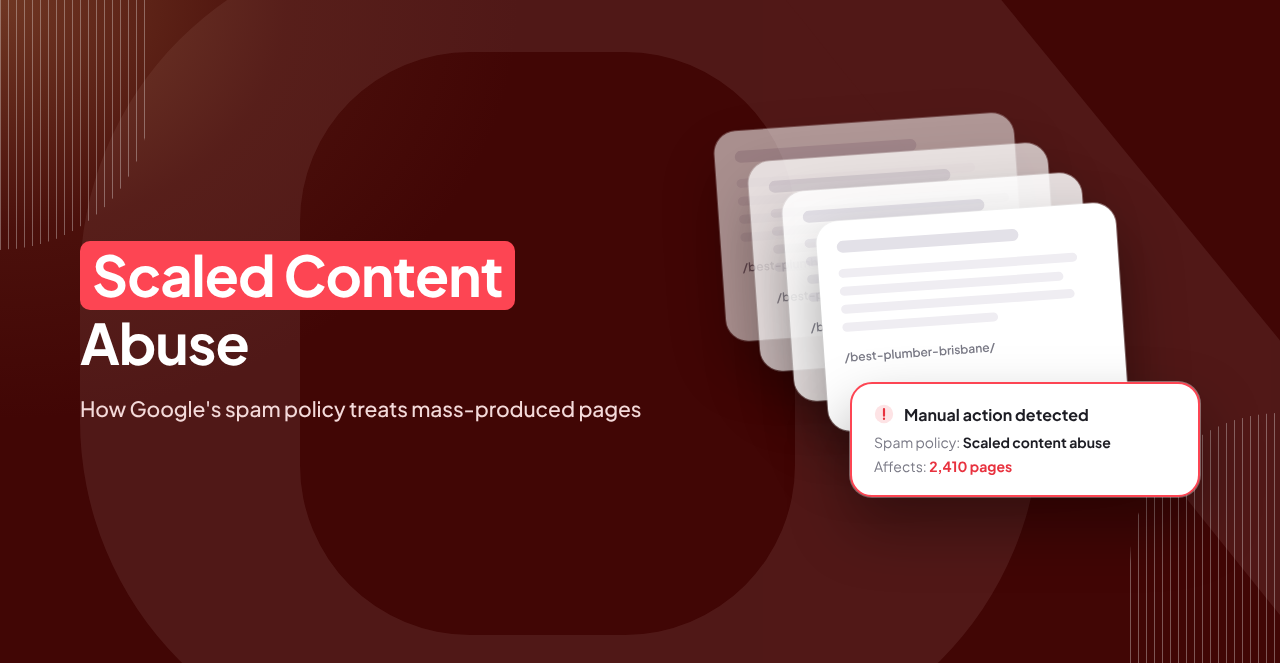
Table of Contents
Scaled content abuse is Google’s name for publishing lots of pages mainly to game search rankings, not to help people. It’s spam, whether a person, an AI tool or both wrote the pages.
So Google doesn’t penalise content just for being AI-written. It penalises content that is mass-made, thin and pointless. AI just makes that much faster to produce.
This guide is for Australian business owners and marketers using ChatGPT or other AI tools for content. You’ll learn where the line sits, what the warning signs look like, and how to use AI without risking your rankings.
Does Google punish AI-written content?
No, Google doesn’t punish content just because AI wrote it. It punishes content made at scale to manipulate rankings, however it was made.
Google’s spam policies describe scaled content abuse as making many pages mainly to manipulate rankings, not to help users. The policy names generative AI tools as one way people do it. It also names human writers, scraping and stitching content from other sites.
Here’s a simple way to picture it.
| Situation | Spam risk |
|---|---|
| You use AI to outline a guide, then write it with your own examples and checks | Low |
| You use AI to draft one page, then a person fact-checks and rewrites it | Low |
| You publish 500 AI suburb pages that only swap the suburb name | High |
| You publish 50 AI blog posts a week with no edits or new facts | High |
| You rewrite competitors’ articles with AI and publish them as your own | High |
If you’d rather have content written by people who know your industry, our copywriting services team writes and edits content for Australian businesses.
What is scaled content abuse?
Scaled content abuse is a Google spam policy against publishing large numbers of low-value pages to rank in search. Google added it in March 2024, along with site reputation abuse and expired domain abuse.
Google’s examples include:
- Using AI tools to make many pages with no added value
- Scraping feeds or search results to create pages
- Stitching together content from other sites without adding anything
- Making many sites to hide how much thin content is being made
- Pages stuffed with keywords that make little sense to a reader
Watch out: Location pages are a classic trap. One template copied across 200 suburbs, with only the name changed, can look like scaled content. Each location page needs something real: local jobs, photos, staff, reviews or prices.
There’s a newer trap too. Google’s AI search guidance warns against one more thing. Don’t make a separate page for every way people might phrase a search, just to game rankings or AI answers. That includes fan-out queries, the follow-up questions AI search asks behind the scenes.
Our guide to what programmatic SEO is shows how to build pages at scale the right way.
Does Google care about AI-generated content?
Google cares about whether content is helpful, accurate and original, not who or what typed it. But it is paying much closer attention to AI content in 2026.
Here’s what has changed this year:
| Date | What happened |
|---|---|
| 15 May 2026 | Google said its spam policies also apply to AI Overviews and AI Mode |
| 24 Sep – 8 Oct 2026 | September 2026 spam update, the fourth spam update this year |
| Oct 2026 | Google added fact-checking expectations to its AI content guidance |
| 5 Nov 2026 | SEOs flagged 6 million+ AI-written Facebook “Answers” pages as possible scaled content abuse |
That last one is worth a closer look. Search Engine Roundtable reported that Meta’s AI-generated answer pages had more than 6 million URLs in Google’s index and were ranking. SEOs called it a clear example of scaled content abuse.
The lesson for smaller sites? Big brands sometimes get away with it for a while. A small business site usually doesn’t have that buffer.
Is AI content harmful for SEO?
AI content is only harmful for SEO when it’s thin, generic, wrong or published in bulk without care. Used well, AI can make good content faster.
The real risks are quieter than a penalty:
- It adds nothing new. If your post says what the top ten results say, Google has no reason to rank it. Many such pages end up “crawled – currently not indexed”.
- It gets facts wrong. AI tools can invent prices, laws or stats. One wrong claim can cost trust.
- It sounds like everyone else. Readers spot AI tone fast and leave.
- It drags down your whole site. Lots of weak pages can make Google trust your good pages less.
We cover the “says nothing new” problem in depth in our post on non-commodity content.
Worried some of your pages look mass-produced? We’ll review your content and flag pages to improve, merge or remove. Book a free strategy call.
Does Google reject AI content?
No. Google indexes and ranks plenty of AI-assisted content. It filters out content its systems see as low value, and it removes content that breaks spam rules.
There are two ways Google acts:
Algorithmic: spam updates and core updates
Google’s automated spam system, called SpamBrain, keeps learning. Spam updates make it better at spotting patterns, like hundreds of near-identical pages. You won’t get a message. You’ll just see rankings and traffic fall.
Manual actions
A person at Google reviews your site and confirms spam. You’ll get a message in Search Console under Security & Manual Actions > Manual actions. Pages or the whole site can drop out of search.
How to tell which one hit you:
| Sign | Likely cause |
|---|---|
| A message in Search Console’s Manual actions report | Manual action |
| Traffic drops in line with a confirmed spam update | Algorithmic spam demotion |
| Traffic drops during a core update | Quality, not spam |
| Pages slowly move to “crawled – currently not indexed” | Google doesn’t see enough value |
If you get a manual action, fix or remove the problem pages, then send a reconsideration request from the same report. Explain what you changed.
Can ChatGPT write SEO content?
Yes, ChatGPT can help write SEO content. But it shouldn’t write it alone, and it shouldn’t publish anything without a person checking it.
Here’s what AI is good at, and where a human must take over:
| Job | AI is good for it? |
|---|---|
| Brainstorming topics and questions | Yes |
| Making a first outline | Yes |
| Summarising your own notes or transcripts | Yes |
| Tidying grammar and shortening sentences | Yes |
| Real examples, results and photos from your business | No |
| Accurate Australian prices, laws and stats | No, check every one |
| Your opinion and what you’d recommend | No |
| Final edit and sign-off | No |
At Adcept, our own writing rules say AI can help draft, but a person must rewrite it in our voice and add first-hand experience. We never publish raw AI output. Every number needs a source we’ve opened and checked.
Want your AI drafts to read like a person wrote them? See our guide on how to make AI writing sound human.
Why should you avoid AI-generated content?
You shouldn’t avoid AI completely. You should avoid AI content that’s published without human checks, real experience or a clear reason to exist.
Before you publish any AI-assisted page, ask these five questions:
If you answer “no” to any of these, the page isn’t ready. That last question is the one Google cares about most.
Our post on why most agency content is worthless explains why “content for content’s sake” fails, AI or not.
Key Takeaways
- Google judges the purpose and value of content, not whether AI wrote it.
- Scaled content abuse can lead to ranking drops from spam updates, or a manual action in Search Console.
- Since 15 May 2026, Google’s spam rules also apply to AI Overviews and AI Mode.
- The safe way to use AI: let it help, then add real experience, facts and a human edit.
Final Remarks
Google doesn’t punish content for being written with AI. It punishes scaled content abuse: pages made in bulk to rank, with little value for readers. Use AI to help, then add real experience, checked facts and a human edit before anything goes live.
Adcept Marketing can review your content, flag pages that look mass-produced and help you build pages that Google and customers trust. Book a free strategy call to get started.
FAQs
Can Google detect AI-generated content?
Google doesn’t need to detect AI to catch spam. Its systems look for patterns of low value, like near-identical pages, thin answers and mass publishing. Google has also said it uses AI to help find AI spam. Focus on whether your content is useful, not on hiding that you used AI.
How do I know if my site has a scaled content abuse penalty?
Check Search Console under Security & Manual Actions. If there’s a manual action, it will say so there. If not, compare your traffic drop with Google’s spam update dates. A drop that lines up with a spam update, across many similar pages, points to an algorithmic problem.
How long does it take to recover from a spam update?
It can take months. You need to improve or remove the problem pages, then wait for Google to recrawl and reassess. Some sites see changes after the next spam or core update. For manual actions, recovery starts after Google approves your reconsideration request.
Is it safe to use AI for location pages?
Only if each page has real local substance. AI can help with structure, but every location page needs unique details like jobs done in that area, local photos, reviews, staff or prices. Copying one page across many suburbs with only the name changed is a common scaled content risk.
Should I delete old AI-generated blog posts?
Not all of them. Review each post first. Improve posts that target a real need, merge posts that overlap, and remove or redirect posts that add nothing. Deleting thin pages can help Google focus on your best content. Always redirect posts that still get links or traffic.
Can an agency audit my site for scaled content risks?
Yes. An agency can review your content, compare it with spam policies and your traffic history, and give you a fix list. At Adcept Marketing, a Melbourne digital marketing and AI automation agency, we audit content and rewrite pages that are worth saving.

Ammar Saleem
Ammar Saleem is a Copywriter at Adcept Marketing who’s spent the last five years helping brands turn smart automation into real results. From search engine optimization to sales funnels and landing pages, he creates content that connects with audiences and drives action. Ammar Saleem has a talent for breaking down complex ideas into clear, practical messaging and he loves helping businesses simplify their marketing so growth feels effortless.
Table of Contents
AI-powered marketing. Eight channels. One customer journey.
Related Insights

Built your site with Lovable, Bolt or another AI tool? These vibe coding SEO checks show if Google can read […]
- AI Work, Digital Marketing

Can you block AI crawlers? Yes, with robots.txt, but it’s a request, not a lock. See which bots to block, which to keep and the new AI training controls.
Can you block AI crawlers? Yes, with robots.txt, but it’s a request, not a lock. See which bots to block, […]
- AI Work, Digital Marketing

Learn how to track AI traffic in GA4, why ChatGPT visits can show as Direct, and how to see Google AI Mode clicks. Simple steps for Australian businesses.
Learn how to track AI traffic in GA4, why ChatGPT visits can show as Direct, and how to see Google […]
- AI Work, Digital Marketing

Crawled currently not indexed means Google read your page and left it out. Learn why it happens, when to ignore it and how to fix the pages that matter.
Crawled currently not indexed means Google read your page and left it out. Learn why it happens, when to ignore […]
- Digital Marketing