Skip to content


Learn how to read Google Search Console’s generative AI performance report, track AI Overviews visibility and measure AI traffic in GA4.
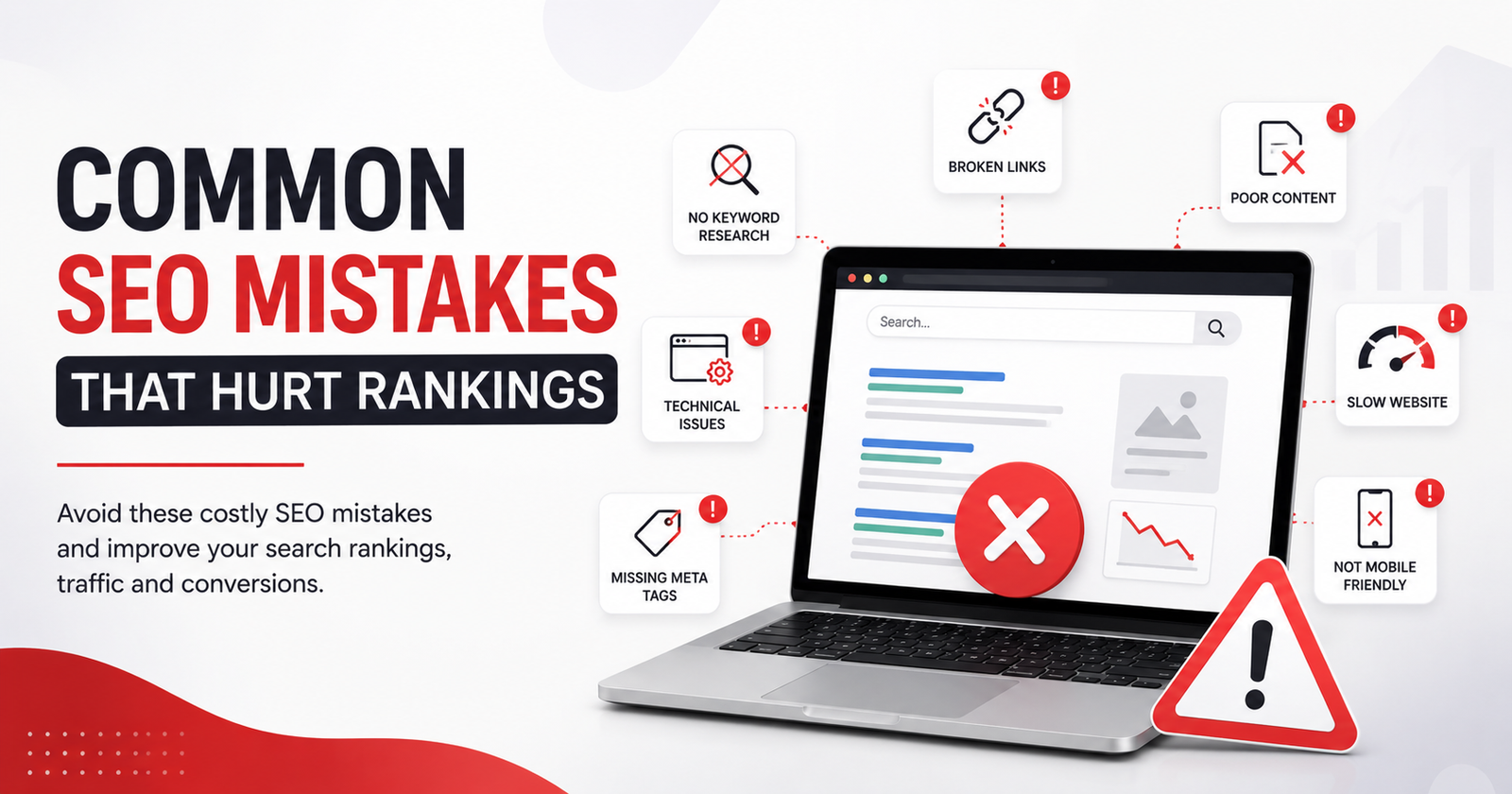
Many businesses invest in content, websites and ads, but still struggle to rank because basic SEO mistakes are holding them back. This SEO Services guide explains the most common issues that damage rankings, including duplicate content, poor site speed, keyword stuffing, weak technical SEO, thin content and poor local optimisation.
Google’s SEO Starter Guide explains that SEO helps search engines crawl, index and understand your content, which means small mistakes can affect how your pages appear in Search.
This article is part of Adcept’s wider SEO content cluster. For a broader strategy, read the guide on SEO strategies for small businesses.
SEO Mistakes
SEO mistakes are website, content or technical issues that make it harder for search engines to crawl, understand, trust or rank your pages.
Common examples include slow pages, duplicate content, missing title tags, broken links, weak service pages, poor mobile experience and unnatural keyword use.
Some mistakes are obvious.
Others sit quietly inside the site until traffic drops or rankings stop improving.
SEO Mistakes?
SEO mistakes are website, content or technical issues that make it harder for search engines to crawl, understand, trust or rank your pages.
Common examples include slow pages, duplicate content, missing title tags, broken links, weak service pages, poor mobile experience and unnatural keyword use.
Some mistakes are obvious.
Others sit quietly inside the site until traffic drops or rankings stop improving.
Why SEO Mistakes Hurt Rankings
SEO mistakes hurt rankings because they create friction for search engines and users. If a page is slow, unclear, duplicated, poorly linked or over-optimised, it may be harder for Google to understand its value.
Search engines want to show helpful, relevant and accessible results.
If your website makes that difficult, your competitors may win the visibility instead.
SEO Services and Ranking Problems
Professional SEO Services often start with finding what is blocking performance before adding more content or chasing new keywords.
A proper SEO review should check:
- Indexing and crawlability
- Duplicate pages
- Page speed
- Mobile usability
- Keyword targeting
- Internal links
- Content quality
- Local SEO signals
- Backlink quality
- Conversion paths
If your business needs support across technical fixes, content planning and local search, Adcept’s SEO Services Australia can help identify the issues that matter most.
SEO Services Checklist for Common Ranking Issues
A good SEO Services checklist should include duplicate content, technical SEO, site speed, keyword usage, local SEO, content quality, internal linking, schema markup and conversion tracking.
The goal is not only to improve rankings.
The goal is to make the website easier to find, understand and use.
Common SEO Mistakes That Hurt Rankings
The most common SEO mistakes that hurt rankings include duplicate content, poor site speed, keyword stuffing, missing metadata, weak internal links, thin content, broken pages, poor mobile experience and under-optimised Google Business Profiles.
Here is a quick comparison.
Duplicate Content
Duplicate content happens when the same or very similar content appears on more than one URL.
This can happen on service pages, product filters, copied location pages, blog tags, HTTP/HTTPS versions, trailing slash variations or printer-friendly URLs.
Google explains that a canonical URL is the representative URL it chooses from a group of duplicate pages, and canonicalisation helps Google show one version in search results.
Why Duplicate Content Is a Problem
Duplicate content can confuse search engines about which page should rank. It can also split internal links, backlinks and relevance signals across several URLs.
Fix duplicate content by:
- Writing unique service page content
- Using canonical tags where needed
- Redirecting outdated duplicates
- Avoiding copied suburb pages
- Cleaning tag and archive pages
- Checking URL parameter issues
- Consolidating similar blogs
For deeper site checks, use the technical SEO audit checklist.
Poor Site Speed
Poor site speed hurts user experience and can affect how visitors engage with your website.
Slow pages often lead to fewer enquiries, lower engagement and weaker conversion rates.
Google says Core Web Vitals are part of what its core ranking systems seek to reward, alongside other page experience aspects.
How to Fix Poor Site Speed
To improve site speed, compress images, reduce unused scripts, use good hosting, enable caching, optimise fonts, limit heavy plugins and improve mobile performance.
Start with these actions:
- Compress large images
- Remove unused plugins
- Use modern image formats
- Reduce render-blocking scripts
- Improve server response time
- Enable browser caching
- Check mobile page speed
- Test key pages, not only the homepage
Poor speed is especially damaging for local service businesses, ecommerce stores and lead generation websites.
If a page takes too long to load, users may leave before seeing the offer.
Keyword Stuffing
Keyword stuffing means forcing keywords into a page too many times to try to manipulate rankings.
It usually makes content awkward, repetitive and less useful.
Google’s spam policies define keyword stuffing as filling a page with keywords or numbers in an attempt to manipulate rankings.
Difference Between Keyword Optimisation and Keyword Stuffing
Keyword optimisation means using relevant terms naturally to help users and search engines understand the page. Keyword stuffing means repeating terms unnaturally to chase rankings.
A good page may include:
- Primary keyword
- Related terms
- Service terms
- Location terms
- FAQs
- Natural synonyms
- Clear headings
- Helpful examples
A poor page repeats the same keyword in every sentence.
For better page structure, read the semantic on-page SEO framework.
Technical SEO Issues
Technical SEO issues can stop strong content from performing.
Even a well-written page may struggle if search engines cannot crawl, index or understand it properly.
Common technical SEO mistakes include:
- Pages blocked by robots.txt
- Noindex tags on important pages
- Broken internal links
- Redirect chains
- Missing XML sitemap
- Duplicate title tags
- Missing canonical tags
- Poor mobile usability
- Incorrect structured data
- Slow server response
- Orphan pages
Why Technical SEO Matters
Technical SEO matters because it controls how search engines access and process your website. If key pages are blocked, broken or poorly structured, they may not rank even if the content is useful.
A strong SEO Services process should check technical health before creating more content.
Otherwise, new pages may inherit the same problems.
Local SEO Mistakes
Local SEO mistakes are common for Australian small businesses.
They usually affect visibility in local searches and Google Maps.
Common local SEO mistakes include:
- Incomplete Google Business Profile
- Wrong business categories
- Inconsistent name, address and phone details
- Few reviews
- No suburb or service area pages
- Weak local content
- No local backlinks
- Ignoring review responses
Google says local ranking is mainly based on relevance, distance and prominence, and complete business information can help Google better understand your business.
For businesses that depend on nearby customers, Local SEO Services can help improve location signals, service area content and Google Business Profile performance.
For more detail, read the guide to local SEO.
Content and Internal Linking Mistakes
Content mistakes are not always about grammar.
They are often about search intent.
A page may be well-written but still fail because it does not answer the question properly.
Common content mistakes include:
- Thin service pages
- Generic blogs
- No clear search intent
- Weak headings
- Missing FAQs
- No examples
- No internal links
- Poor calls to action
- Copying competitor structure
- Writing for keywords instead of customers
Google’s AI optimisation guidance says SEO fundamentals remain relevant for AI features, because AI Overviews and AI Mode are rooted in Google’s core Search ranking and quality systems.
How Internal Links Help SEO
Internal links help users and search engines move between related pages. They also show which pages are important and how topics connect across your site.
Useful internal links for this cluster include:
Good internal linking helps build topical authority.
It also helps users find the next useful page.
Real Business Example
A Melbourne consulting firm has 20 service pages, but rankings are flat.
An SEO audit finds:
- Five service pages target the same keyword
- Several pages have copied intro text
- Images are too large
- Google Business Profile is incomplete
- Blog posts do not link to service pages
- Some pages have duplicate title tags
- Important pages are buried three clicks deep
The fix is not just “write more blogs”.
The better plan is:
- Consolidate duplicate service pages
- Rewrite pages around clear search intent
- Improve page speed
- Update Google Business Profile
- Add internal links from blogs to services
- Fix title tags and meta descriptions
- Build a content cluster around core services
- Track calls, forms and keyword movement
This is how an SEO Agency Melbourne should approach ranking problems: diagnose first, then improve.
Benefits and Challenges
Benefits of Fixing SEO Mistakes
Fixing SEO mistakes can improve visibility, crawlability, user experience and conversion performance.
Benefits include:
- Better indexation
- Faster pages
- Clearer keyword targeting
- Stronger local visibility
- Improved user experience
- Better internal link flow
- More useful content
- Higher enquiry potential
Challenges of Fixing SEO Mistakes
Some SEO issues are easy to find but harder to fix.
Challenges include:
- Messy old websites
- Limited developer support
- Poor CMS setup
- Duplicate pages created over years
- Weak content briefs
- No analytics tracking
- Low-quality backlinks
- Unclear business priorities
This is where experienced SEO Services can help separate urgent fixes from low-impact tasks.
Best Practices
Best Practices for SEO Services
Effective SEO Services should focus on technical health, search intent, content quality, local relevance, ethical links, clean reporting and long-term improvement.
Use these best practices:
- Audit before creating new pages
- Fix indexation issues first
- Consolidate duplicate content
- Improve site speed on key pages
- Use keywords naturally
- Build topic clusters
- Strengthen internal links
- Optimise Google Business Profile
- Track calls, forms and leads
- Review Search Console regularly
Expert Tip
Do not fix every SEO issue with the same level of urgency.
Prioritise problems that affect crawlability, indexation, important service pages, conversion paths and local visibility first.
Common Mistakes to Avoid
Avoid these repeated mistakes:
- Publishing copied location pages
- Ignoring mobile speed
- Using the same title tag everywhere
- Writing for word count only
- Adding keywords unnaturally
- Forgetting internal links
- Not tracking conversions
- Ignoring Google Business Profile
- Buying low-quality backlinks
- Publishing AI content without review
SEO is not about doing more tasks.
It is about doing the right tasks in the right order.
Future Trends
SEO mistakes are changing as search becomes more AI-assisted.
Search engines and AI systems need clear, trustworthy and well-structured content.
Future SEO risks include:
- Publishing large volumes of low-quality AI content
- Ignoring entity-based search
- Weak author and business trust signals
- Poor structured data
- Thin content clusters
- No first-hand experience
- Poor local proof
- Weak page experience
Businesses should focus on useful content, technical quality, authority and clear internal linking.
That approach supports both traditional search and AI-powered search results.
Quick Summary
The biggest SEO mistakes that hurt rankings are duplicate content, poor site speed, keyword stuffing, technical errors, weak local SEO and thin content.
A strong SEO Services strategy should diagnose these issues before creating more pages.
Fix the foundation first.
Then build content and authority.
Conclusion
Common SEO mistakes can quietly damage rankings, traffic and enquiries.
Duplicate content confuses search engines.
Poor site speed frustrates users.
Keyword stuffing weakens trust.
Technical errors block performance.
Weak local SEO makes it harder for nearby customers to find you.
The best SEO Services do not simply publish more content. They diagnose the barriers, fix the foundations and then build a clear growth plan.
For Australian businesses that want a structured approach, Adcept’s SEO Services Australia can support audits, technical fixes, local SEO, content strategy and ongoing optimisation.
Key Takeaways
- SEO mistakes can affect crawling, indexing, rankings and conversions.
- Duplicate content should be consolidated, rewritten or canonicalised.
- Poor site speed can reduce engagement and weaken page experience.
- Keyword stuffing is risky and makes content harder to read.
- Technical SEO issues should be fixed before scaling content.
- Local SEO mistakes can reduce visibility in Google Maps and local search.
- Internal links help build topical authority and guide users.
- SEO should be prioritised by business impact, not task volume.
FAQs
1. What are the most common SEO mistakes?
The most common SEO mistakes include duplicate content, poor site speed, keyword stuffing, broken links, thin content, missing metadata, weak internal links and poor local SEO setup.
2. Can duplicate content hurt SEO rankings?
Yes. Duplicate or very similar pages can confuse search engines about which page should rank. Use canonical tags, redirects or unique content to fix the issue.
3. Is keyword stuffing bad for SEO?
Yes. Keyword stuffing is against Google’s spam policies and makes content hard to read. Use keywords naturally and focus on search intent.
4. Does site speed affect SEO?
Site speed affects user experience and can support SEO performance. Core Web Vitals are part of page experience, but useful content and relevance still matter.
5. Why is my website not ranking on Google?
Common reasons include poor technical SEO, weak content, duplicate pages, no backlinks, poor local SEO, slow pages, missing internal links or targeting keywords that are too competitive.
6. How do I fix SEO mistakes?
Start with an SEO audit. Check indexation, duplicate pages, page speed, metadata, content quality, internal links, local SEO signals and backlinks. Then prioritise the issues with the biggest business impact.
7. Are SEO Services worth it for small businesses?
Yes, if the service focuses on strategy, technical fixes, content quality, local visibility and measurable leads. Avoid providers that only promise rankings without explaining the work.
8. How often should I audit my website for SEO issues?
Most small businesses should review SEO performance monthly and run a deeper audit every 3 to 6 months. Larger or ecommerce sites may need more frequent checks.